
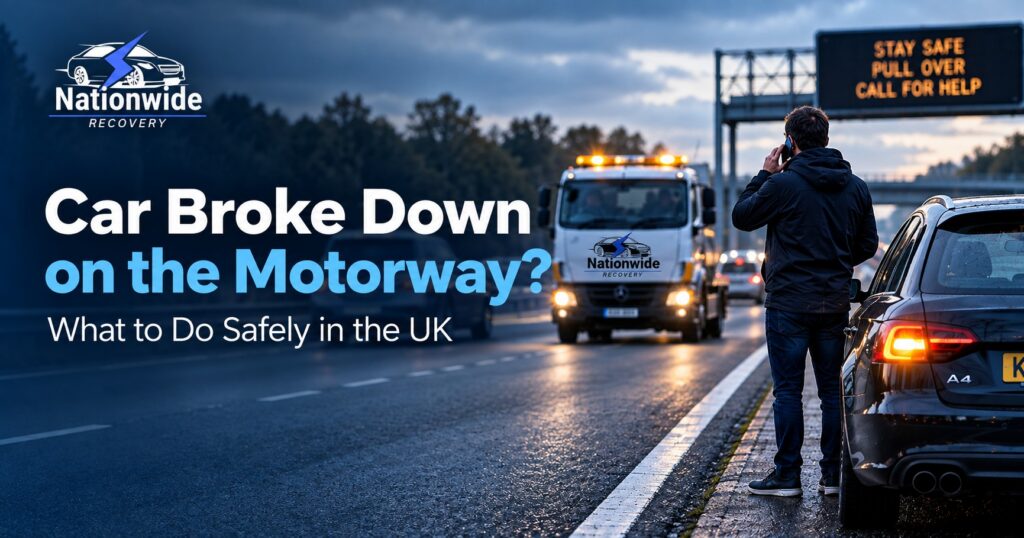
If your car broke down on motorway, try to leave at the next exit or enter a service area. If that is not possible, move left into an emergency area or hard shoulder when safely available. Switch on your hazards, get away from traffic when safe and arrange professional help.
If you cannot reach a safer place or exit the vehicle safely, stay seatbelted inside, keep your hazards on and call 999 immediately for the police.
The current Highway Code calls a service area the safest place to stop on a motorway or other high-speed road. It also warns that hard shoulders offer less protection because they remain close to fast-moving traffic.
National Highways traffic officers deal with more than 85,000 breakdowns each year, and over 40% involve fuel, tyre maintenance, power loss or engine trouble.
This guide explains what UK motorists should do from the first sign of trouble until professional breakdown recovery arrives.
What Should You Do First?
If your vehicle develops a problem on the motorway, your first goal is to reach a place of relative safety. Keep control, avoid sudden movements and leave the motorway at the next exit or service area if the vehicle can safely continue that far.
Watch for warning signs such as:
- sudden loss of engine power;
- unusual vibration;
- dashboard warning lights;
- steering changes;
- tyre problems;
- overheating warnings;
- unusual engine sounds.
Switch on your hazard lights if your vehicle is slowing unusually or becoming an obstruction.
Do not focus on diagnosing the vehicle while it is moving.
Your priority is getting yourself, your passengers and the vehicle away from live traffic.
Where Is the Safest Place?
The Highway Code describes the safest motorway stopping location as somewhere designed for parking.
The order is generally:
| Location | Relative Safety | Best Action |
| Service area | Highest | Stop safely and arrange assistance |
| Motorway exit | High | Leave motorway and stop safely |
| Emergency area | Safer roadside option | Stop fully inside the area |
| Hard shoulder | Emergency option | Stop as far left as possible |
| Live lane | Immediate danger | Call 999 if unable to get clear |
A hard shoulder should therefore be treated as an emergency location rather than a normal waiting place.
What If You Reach the Hard Shoulder?
If you cannot leave the motorway but can safely reach the hard shoulder, stop as far left as possible and turn the wheels towards the left. Switch on your hazards and use sidelights when visibility is poor.
Apply the parking brake.
Turn the engine off.
If it is safe to exit, use the door furthest from traffic.
Passengers should follow the same route.
Move away from both the vehicle and moving traffic.
Where a safety barrier exists, move behind it if the ground allows you to do so safely.
Do not stand immediately in front of or behind the vehicle.
Then contact professional motorway breakdown recovery.
What Is an Emergency Area?
An emergency area is a designated motorway stopping place for emergencies and breakdowns. It is usually identified by blue signs featuring an orange SOS telephone symbol and may have orange road surfacing.
The Highway Code states that emergency areas must only be used in emergencies.
If you enter one:
- Stop fully within the marked area.
- Move as far from live traffic as possible.
- Switch on your hazard lights.
- Leave through the traffic-free side when safe.
- Use the emergency telephone.
- Follow the operator’s instructions.
Do not simply drive back onto the motorway when your vehicle becomes mobile again.
The Highway Code says drivers leaving an emergency area must use the emergency telephone and follow the operator’s advice. A lane may need to be closed before you rejoin.
What If You Stop in a Live Lane?
A vehicle stopped in a live motorway lane creates an immediate safety situation. If you cannot move left or reach a place of relative safety, keep your hazards on, keep seatbelts fastened and call 999 immediately for the police.
Do not attempt to cross moving lanes on foot.
Do not get out merely because the vehicle has stopped.
The Highway Code specifically states that when motorists cannot reach the left lane or another place of relative safety, and cannot exit safely, they should remain inside and call 999.
If you can safely reach a protected location without entering moving traffic, follow the instructions of emergency services or National Highways.
Professional vehicle recovery can be arranged once the immediate road danger has been controlled.
Should You Leave the Car?
The answer depends on where you stop.
On a Hard Shoulder
Leave through the side furthest from traffic when it is safe.
Move well away from the vehicle.
Stand behind a barrier where available.
In an Emergency Area
Follow the emergency-area instructions.
Move to a protected position.
Use the SOS telephone where instructed.
In a Live Lane
Do not automatically exit.
If you cannot get safely away from moving traffic:
- stay inside;
- keep seatbelts fastened;
- keep hazards on;
- call 999.
Safety conditions around the vehicle always take priority over a generic instruction.
Never Use a Warning Triangle
Do not place a warning triangle anywhere on a motorway.
The Highway Code specifically says warning triangles must never be used on motorways.
Walking along the motorway to position one creates unnecessary exposure to high-speed traffic.
Leave the triangle inside your vehicle.
Should You Repair the Car?
Do not attempt roadside repairs on a motorway. Move to safety and arrange professional assistance instead.
Even a simple battery, wheel or engine check can place you close to traffic.
If your vehicle will not start because of a battery-related problem, Nationwide Recovery provides jump-start and battery assistance.
For tyre issues, mobile tyre assistance may be suitable once the vehicle is in an accessible and safe location.
For an unknown fault, vehicle diagnostics can help identify what caused the vehicle to stop.
If a roadside solution is not appropriate, vehicle towing or recovery can move the car safely.
What About Children?
Children should remain under close supervision throughout the breakdown.
If everyone can exit safely:
- use doors away from traffic;
- keep children close;
- move behind a barrier;
- do not allow anyone back to the car.
If you cannot leave safely, keep everyone seatbelted and call 999.
Tell the recovery operator if young children or anyone requiring additional assistance is travelling with you.
What About Pets?
The Highway Code says animals should remain in the vehicle or, in an emergency, be kept under proper control on the verge.
Do not release a pet beside motorway traffic.
Tell your recovery operator that an animal is travelling with you.
This helps the team understand your situation before arrival.
What If You Break Down in Roadworks?
Motorway roadworks can provide less stopping space than normal motorway sections.
If your car develops a problem:
- Keep control.
- Follow temporary signs.
- Leave at the next safe opportunity.
- Use any available emergency area.
- Keep hazards on if the vehicle slows significantly.
- Call 999 if you become stranded in a live lane.
Never move cones, barriers or temporary traffic-management equipment yourself.
Follow instructions from police, National Highways traffic officers or authorised road workers.
Who Should You Call?
Once you are in a safe location, contact a professional recovery provider.
Nationwide Recovery provides 24/7 breakdown recovery for vehicles that cannot continue their journey.
Depending on the issue, the situation may instead require:
- roadside assistance;
- vehicle towing;
- jump-start assistance;
- mobile tyre support;
- vehicle diagnostics.
Call 999 before recovery if you or other road users face immediate danger.
What If You Have No Cover?
You do not need an existing annual breakdown membership to contact an independent recovery operator. Once you are safe, you can arrange a direct call-out and pay for the roadside assistance or vehicle recovery you require.
Breakdown cover itself is not a legal requirement in the UK. Current RAC guidance confirms that drivers without existing cover can still arrange emergency help, although charges may apply.
Nationwide Recovery provides direct breakdown recovery for motorists who need vehicle assistance.
For a full explanation, read What to Do When Your Car Breaks Down: Step-by-Step Guide
What Information Does Recovery Need?
Giving accurate information can make the response easier to arrange.
Tell the operator:
Your Location
Give:
- motorway number;
- direction of travel;
- nearest junction;
- nearest service area;
- emergency-area number;
- marker-post information;
- a map pin when available.
The Highway Code confirms that mapping applications, marker posts and driver-location signs can help communicate your motorway location.
Your Vehicle
Provide:
- registration;
- make and model;
- fuel type;
- vehicle size;
- whether it is electric or hybrid.
What Happened
Describe symptoms rather than guessing.
For example:
- engine lost power;
- tyre failed;
- car will not start;
- warning light appeared;
- vehicle overheated;
- wheel will not turn.
If the vehicle cannot roll normally because of locked wheels or another mobility problem, vehicle skate recovery may be relevant.
What If the Engine Cuts Out?
If the engine suddenly stops while you are driving, maintain control and move towards a safer position when possible.
Switch on your hazards.
Avoid sudden steering or braking.
Some vehicles may feel different once engine power or assistance is lost.
Once stopped safely, arrange assistance rather than continuing the journey without understanding the cause.
Common Motorway Breakdown Causes
National Highways says over 40% of the breakdowns its traffic officers handle involve running out of fuel, poor tyre maintenance, power loss or engine trouble.
Typical roadside situations therefore include:
| Situation | Appropriate Help |
| Flat battery | Jump-start assistance |
| Damaged tyre | Mobile tyre assistance |
| Engine problem | Diagnostics/recovery |
| Loss of power | Diagnostics/recovery |
| Vehicle cannot move | Breakdown recovery |
| Locked wheels | Skate recovery |
| Vehicle needs transport | Towing/recovery |
The safest response depends on where the vehicle stops and what symptoms appear.
Can Motorway Breakdowns Be Prevented?
Not every breakdown is predictable, but simple vehicle checks can reduce avoidable incidents.
National Highways reported that the number of breakdowns recorded on major roads increased by 24% over four years, while tyre issues accounted for 19% of recorded breakdowns in 2025.
Before longer motorway journeys:
- check tyre pressures;
- inspect tread and damage;
- check fuel or EV charge;
- inspect oil and fluids;
- respond to dashboard warnings;
- ensure your phone is charged.
National Highways recommends keeping sufficient fuel and says all tyres must meet the legal tread requirements.
Motorway Breakdown Checklist
Save this sequence:
Problem develops → Go left → Get safe → Get help
- Leave at the next exit if possible.
- Use a service area if accessible.
- Otherwise move left.
- Enter an emergency area or hard shoulder.
- Turn on hazards.
- Exit away from traffic when safe.
- Wait behind a barrier.
- Never use a warning triangle.
- Contact recovery.
- Call 999 if you cannot get clear safely.
Need Motorway Breakdown Recovery?
If your car broke down on motorway, safety comes first.
Get left where possible, get yourself and your passengers safe, then get professional help.
Nationwide Recovery provides 24/7 breakdown recovery, roadside assistance and vehicle towing for drivers who need reliable vehicle assistance.
Call Nationwide Recovery: 0161 706 0346
Frequently Asked Questions
Question: What should I do if my car breaks down on the motorway?
Answer: Try to leave the motorway at the next exit or enter a service area. If that is impossible, move left into an emergency area or hard shoulder when safe. Use hazards, move away from traffic where possible and contact professional recovery.
Question: Should I call 999 for a motorway breakdown?
Answer: Call 999 if you cannot reach a place of relative safety or cannot exit safely. Stay inside with seatbelts fastened and hazards on while waiting for instructions.
Question: Can I stay in my car?
Answer: If safely stopped on a hard shoulder, getting behind a barrier is normally preferable when conditions allow. If stranded in a live lane and exiting is unsafe, remain seatbelted inside and call 999.
Question: Can I use a warning triangle?
Answer: No. Warning triangles must never be placed on a motorway.
Question: Can recovery collect me from a motorway?
Answer: Professional vehicle recovery can assist once the vehicle is in an appropriate location and any immediate traffic danger has been managed.
Question: What if I have no breakdown cover?
Answer: You can contact an independent recovery operator directly and pay for the assistance you require. An existing annual membership is not always necessary.
Question: Can I repair the vehicle myself?
Answer: Do not attempt repairs on the motorway. Arrange professional assistance after reaching the safest available location.