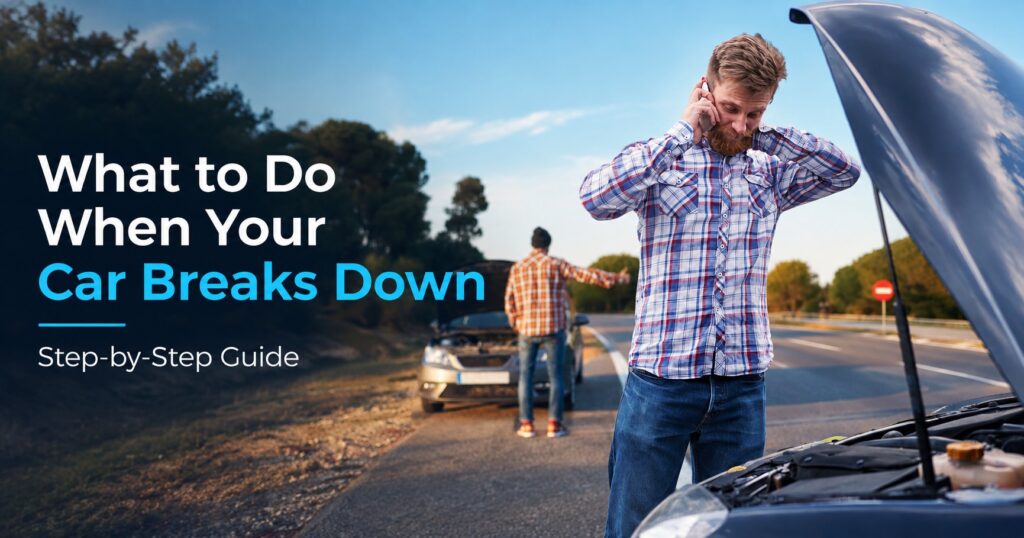
If you are wondering what to do when car breaks down, put safety before the vehicle. Move somewhere safer if possible, switch on your hazard lights, keep away from moving traffic, identify your location and contact professional assistance.
Never put yourself in danger to inspect or repair the vehicle.
National Highways says recorded breakdowns on major roads increased by 24% over four years. It also reported that tyre problems caused 19% of recorded breakdowns in 2025.
Nationwide Recovery provides breakdown recovery and roadside assistance for drivers who need help after a vehicle stops unexpectedly.
This guide explains exactly what UK drivers should do on ordinary roads, motorways, dual carriageways and other high-speed roads.
What Should You Do First?

The first thing to do after a car develops a problem is protect yourself and other road users. Do not focus on diagnosing the fault until you have reached the safest position reasonably available.
If the vehicle still moves, stay calm.
Avoid braking sharply unless the situation requires it.
Signal left when appropriate and move away from active traffic.
Switch on your hazard lights if the vehicle is creating an obstruction.
If the vehicle loses power, use its remaining momentum carefully.
Do not make a dangerous lane change simply to reach the roadside.
Once stopped:
- Apply the parking brake.
- Select park or an appropriate gear.
- Switch on hazard lights.
- Use sidelights in darkness or poor visibility.
- Assess whether leaving the vehicle is safe.
Your personal safety matters more than preventing further damage to the car.
Breakdown Actions by Road Type
Use this table as a quick decision guide.
| Situation | Where to Stop | Leave Vehicle? | Warning Triangle? | Who to Call |
| Quiet ordinary road | Safe position off road where possible | If safe | At least 45 metres behind if safe | Recovery service |
| Busy urban road | Away from moving traffic | Only if safe | Only when safe | Recovery service |
| Motorway hard shoulder | As far left as possible | Usually, if safe | Never | Recovery service |
| Motorway emergency area | Inside designated area | Follow safe exit guidance | Never | Emergency phone/recovery |
| Motorway live lane | Move left if safely possible | Only if you can reach safety | Never | 999 first |
| High-speed dual carriageway | Safe place away from carriageway | Only if safe | Only if placing it creates no risk | Recovery service or 999 if dangerous |
| Home/private property | Safe parked position | Usually | Normally unnecessary | Recovery/mechanic |
Individual road conditions always take priority over a general checklist.
What to Do on a Normal Road
If your car breaks down on an ordinary UK road, move it off the road where possible. Switch on the hazards and wait somewhere protected from moving traffic.
The Highway Code says drivers should get a broken-down vehicle off the road where possible.
If the vehicle creates an obstruction, use your hazard warning lights.
Next, look at your surroundings.
A quiet lay-by, parking area or side road may provide a safer waiting place.
Do not stand between your vehicle and approaching traffic.
Wear bright or reflective clothing if available.
At night, keep your sidelights on when visibility requires them.
Once everyone is safe, contact a professional breakdown recovery service.
Can You Use a Warning Triangle?
Yes, a warning triangle can be used on appropriate non-motorway roads when it is safe. The Highway Code says it should be placed at least 45 metres behind the vehicle on the same side of the road.
That distance equals approximately 147 feet.
However, never walk into a dangerous traffic situation simply to position a triangle.
Never Use One on a Motorway
The Highway Code specifically says never use warning triangles on motorways.
Your safety takes priority over warning equipment.
What to Do on a Motorway
If your car breaks down on a motorway, try to leave at the next exit or reach a motorway service area. If that is impossible, move left towards an emergency area or hard shoulder when available.
The Highway Code advises motorists experiencing a vehicle problem to leave the carriageway where possible.
1. Go Left Safely
Move towards the left lane.
Do not cut across traffic suddenly.
Use an emergency area or hard shoulder if one is safely accessible.
Stop as far left as reasonably possible.
Turn your wheels towards the left.
2. Make the Vehicle Visible
Switch on your hazard lights.
Use sidelights when it is dark or visibility is poor.
Do not place a warning triangle on the motorway.
3. Get to a Safer Place
If you can safely leave the vehicle, exit from the side furthest from traffic.
For most UK cars stopped on the left, this will usually be the passenger side.
Ask passengers to do the same.
Move well away from the vehicle and carriageway.
Stand behind a safety barrier where one is available.
Do not stand directly behind your broken-down vehicle.
4. Call for Assistance
Once safe, contact professional vehicle breakdown recovery.
Tell the operator that you are on a motorway.
Provide the motorway number and direction.
Also provide your nearest junction, service area or visible location marker.
What If You Stop in a Live Lane?
A live-lane breakdown is an emergency. If you cannot move the vehicle into a safer position or cannot leave it safely, keep your hazards on, stay seatbelted and call 999.
Do not step into fast-moving traffic.
Do not attempt to push the vehicle across motorway lanes.
Do not stand beside the car.
The Highway Code says drivers should call 999 immediately and ask for the police when they cannot safely leave their vehicle or reach a place of relative safety.
After the immediate danger has been managed, breakdown recovery can be arranged.
What About Motorways Without Hard Shoulders?
If there is no permanent hard shoulder, try to reach the next exit, service area or designated emergency area. If your vehicle stops in a live lane and you cannot get clear safely, call 999.
Look for emergency-area signs.
If you reach an emergency area, stop as far from moving traffic as possible.
Use the emergency telephone when instructed.
These phones can help the road operator establish your location.
Do not walk along live motorway lanes looking for help.
A Current 2026 eCall Warning
Some newer cars contain an SOS or eCall system.
However, drivers should not assume every newer system currently works.
The UK Government stated in July 2026 that Next Generation eCall may not operate before 31 March 2027 because network upgrades are still required.
This applies to relevant newer vehicles registered from 1 September 2025.
Until then, GOV.UK advises drivers not to rely on NG eCall during an emergency. Use a mobile phone or roadside SOS telephone instead.
This advice may change after the network upgrade, so drivers should check current government guidance.
Should You Stay Inside the Car?
Whether you should leave a broken-down vehicle depends on where it has stopped. On a motorway shoulder, leaving through the traffic-free side and waiting behind a barrier is normally safer when this can be done safely.
However, the answer changes in a live traffic lane.
If leaving means walking into moving traffic, remain inside.
Keep your seatbelt fastened.
Switch on your hazard lights.
Call 999.
Never follow a generic instruction when the conditions around you make it dangerous.
What About Children and Passengers?
Passengers should follow the same safety principle: get away from moving traffic only when there is a safe route to do so. Children require close supervision throughout the process.
Explain what is happening before opening doors.
Do not let children stand between the broken-down vehicle and traffic.
Keep everyone together in a protected location.
If someone has mobility difficulties, tell the emergency services or recovery operator.
What Should You Do With Pets?
Pets can complicate a roadside evacuation.
Never allow an animal to run loose near moving traffic.
Assess the location before opening any door.
On a motorway, moving an uncontrolled animal towards traffic may create another emergency.
Tell your recovery operator that you have an animal with you.
This allows the operator to understand your situation before arriving.
Who Should You Call?
Call a breakdown or vehicle recovery company when the vehicle is safely stopped. Call 999 first when the vehicle or occupants face immediate danger.
The difference matters.
Call Recovery When:
- Your vehicle is safely off the carriageway.
- You cannot restart the vehicle.
- You have a mechanical problem.
- A battery has failed.
- A tyre problem prevents travel.
- The vehicle requires towing.
- Roadside repair is not practical.
Nationwide Recovery offers professional roadside assistance, breakdown recovery and vehicle towing.
Call 999 When:
- Your car has stopped in a live motorway lane.
- You cannot reach a safer position.
- You cannot safely leave the vehicle.
- A collision has caused injuries.
- There is fire or another immediate threat.
- The vehicle creates an immediate serious road hazard.
Emergency services are for danger, not routine mechanical failures.
What If You Have No Breakdown Cover?
You can still arrange vehicle recovery if you do not have breakdown membership. Contact an independent recovery operator and explain that you need a direct call-out.
Do not assume you must have an existing annual policy.
First make yourself safe.
Then tell the recovery company:
- Where you are.
- What vehicle you have.
- What happened.
- Whether the car moves.
- Where you want it taken.
If you are in immediate danger, call 999 before arranging recovery.
Nationwide Recovery provides 24/7 breakdown recovery for drivers who need direct assistance.
What Information Does Recovery Need?
A recovery operator can usually dispatch more effectively when you provide your precise location, vehicle details, visible symptoms and the destination required.
Location
Give:
- Road name or number.
- Direction of travel.
- Nearest junction.
- Postcode when available.
- Nearby landmark.
- Motorway marker information.
- Map pin if available.
Vehicle
Provide:
- Make.
- Model.
- Registration.
- Approximate size.
- Fuel type.
- Whether it is electric or hybrid.
Vehicle Condition
Explain what you actually know.
For example:
- Engine will not start.
- Battery appears flat.
- Tyre is damaged.
- Vehicle lost power.
- Warning light appeared.
- Steering is affected.
- Wheel will not turn.
- Vehicle cannot select neutral.
- Keys are unavailable.
Avoid guessing about mechanical faults.
Describe what happened instead.
If your vehicle has locked or seized wheels or cannot be moved normally, specialist vehicle skate recovery may be suitable.
Destination
If recovery is required, decide where the vehicle should go.
That might be:
- Your home.
- A garage.
- A dealership.
- Another agreed location.
Giving this information early can make recovery arrangements clearer.
Roadside Help or Vehicle Recovery?
These services solve different problems.
| Roadside Assistance | Vehicle Recovery |
| Attempts to solve suitable roadside problems | Moves a vehicle that cannot continue |
| May provide a jump start | Can transport a non-running vehicle |
| May assist with some tyre issues | Useful after serious mechanical failure |
| May provide minor roadside assistance | Takes vehicle to an agreed destination |
| Goal is to get vehicle moving | Goal is to move vehicle safely |
If the problem can be resolved safely at the roadside, roadside assistance may be suitable.
If not, breakdown recovery may be required.
For vehicles that simply need moving, see Nationwide Recovery’s vehicle towing service.
Can You Repair the Car Yourself?
Only consider a simple check when the vehicle is completely away from dangerous traffic and you can work safely. Never attempt roadside repairs in an exposed motorway or high-speed traffic location.
Your first task is not diagnosing the fault.
Your first task is controlling risk.
A battery issue may require professional jump-start and battery assistance.
A damaged tyre may require mobile tyre assistance.
If you are unsure why the vehicle has developed a fault, Nationwide Recovery also provides vehicle diagnostics.
Mechanical or electrical failures that cannot be resolved safely may require vehicle recovery.
Do not crawl underneath a roadside vehicle.
Do not stand beside traffic while inspecting the engine.
Do not attempt a repair simply because it appears easy.
What If You Break Down at Night?
At night, increase visibility but avoid standing where passing drivers may not see you. Use hazard lights and sidelights where appropriate, then move to a protected waiting position when safe.
Reflective or high-visibility clothing can make you easier to see.
Keep a charged mobile phone available.
A portable power bank is also useful.
Tell your recovery provider if the location feels unsafe.
Give the operator clear landmarks and your direction of travel.
Do not walk along an unlit carriageway.
If your vehicle cannot continue, arrange professional 24-hour vehicle recovery.
What If the Weather Is Bad?
Rain, fog, snow and ice can increase roadside risk.
Visibility may be lower.
Stopping distances can also increase.
Therefore, avoid unnecessary movement around the vehicle.
Use appropriate vehicle lights.
Wear visible clothing if you need to leave the car.
Stand farther from moving traffic when possible.
Do not attempt a roadside repair when poor visibility makes the location unsafe.
Common Causes of Car Breakdowns
A breakdown can result from several mechanical or electrical problems.
Common examples include:
| Symptom | Possible Cause | Sensible Next Step |
| Clicking or no engine start | Battery problem | Arrange battery/jump-start assistance |
| Flat or damaged tyre | Puncture or tyre failure | Stop safely and request tyre help |
| Engine temperature rises | Cooling-system problem | Stop safely and seek professional help |
| Sudden loss of power | Mechanical/electrical fault | Move to safety and arrange assistance |
| Fuel warning followed by stopping | Fuel shortage | Arrange safe assistance |
| Warning lights | Various vehicle faults | Follow handbook guidance and seek help |
| Vehicle cannot move | Mechanical/drive-system issue | Arrange vehicle recovery |
A flat or weak battery may only require jump-start assistance.
A puncture or damaged tyre may require mobile tyre fitting and assistance.
More complex warning lights or electrical faults may need vehicle diagnostic services.
Do not use this table as a remote diagnosis.
Different faults can produce similar symptoms.
How Common Are Preventable Breakdowns?
National Highways says its traffic officers deal with more than 85,000 breakdowns each year.
It states that over 40% involve issues including fuel, tyre maintenance, power loss and engine trouble.
Simple checks therefore matter.
Before longer journeys, inspect:
- Fuel or charge level.
- Tyre condition.
- Tyre pressure.
- Fluid levels.
- Dashboard warnings.
- Lights.
- Battery condition.
The legal minimum tyre tread depth for most cars is 1.6mm across the required part of the tyre.
What Should You Keep in Your Car?
A basic emergency kit can make waiting safer and easier.
Consider carrying:
- High-visibility clothing.
- Warning triangle for suitable non-motorway use.
- Charged mobile phone.
- Power bank.
- Torch.
- Charging cable.
- Drinking water.
- Warm clothing or blanket.
- Basic first-aid kit.
- Vehicle handbook.
- Breakdown or recovery contact details.
Keep safety equipment somewhere accessible.
Equipment buried underneath a fully loaded boot may be difficult to reach.
What Happens After You Call Recovery?
After you request recovery, stay in the safest available location and remain contactable. The operator will use your location and vehicle information to decide what equipment may be needed.
A roadside technician may first determine whether suitable roadside assistance can get the vehicle moving.
If that is not practical, vehicle breakdown recovery may be arranged.
The vehicle can then be transported to an agreed destination.
Do not return to an exposed vehicle unnecessarily while waiting.
Keep your telephone available in case the recovery operator needs additional directions.
How Can You Prevent Another Breakdown?
Regular maintenance cannot prevent every breakdown, but it can reduce avoidable roadside problems. Check the vehicle before long journeys and respond early to warning signs.
Pay particular attention to:
Tyres
Check pressure, tread and visible damage.
Do not ignore bulges or cuts.
If a tyre becomes unusable while travelling, mobile tyre assistance may help get the situation resolved safely.
Battery
Watch for slow starting or repeated battery problems.
Arrange testing if the battery appears weak.
Nationwide Recovery provides jump-start and battery replacement assistance when a battery problem leaves a vehicle unable to start.
Fluids
Check levels according to the vehicle manufacturer’s instructions.
Fuel or EV Charge
Do not start a long journey with insufficient range.
Dashboard Warnings
Never ignore a warning light simply because the vehicle still moves.
Consult your vehicle handbook.
If the cause is unclear, vehicle diagnostics may help identify the fault.
Servicing
Follow the manufacturer’s recommended service schedule.
Preventative maintenance is easier than dealing with a roadside failure.
60-Second Breakdown Checklist
Save these steps for an emergency:
CAR BREAKS DOWN →
- Keep control.
- Move left or off the road when safe.
- Turn hazards on.
- Stop somewhere safer.
- Leave only when safe.
- Get passengers away from traffic.
- Never use a warning triangle on a motorway.
- Find your exact location.
- Call recovery.
- Call 999 if you cannot reach safety.
Safety comes before the vehicle.
Need Breakdown Recovery?
Knowing what to do when your car breaks down can protect you during the first critical minutes. The most important rule is simple: protect people before worrying about the vehicle.
If your vehicle cannot continue safely, Nationwide Recovery provides 24/7 breakdown recovery, roadside assistance and vehicle towing.
Whether the problem involves a flat battery, tyre issue, mechanical failure or vehicle that cannot move, professional help can get the situation under control.
Call Nationwide Recovery: 0161 706 0346
Frequently Asked Questions
Question: What is the first thing to do if your car breaks down?
Answer: Move towards a safe stopping place if the vehicle still moves. Avoid sudden manoeuvres, switch on your hazard lights when appropriate and get yourself away from moving traffic before inspecting the problem or calling breakdown recovery.
Question: Should I call 999 if my car breaks down?
Answer: A normal breakdown does not usually require 999. Call 999 when there is immediate danger, including when you are stranded in a live motorway lane and cannot move the vehicle or reach safety.
Question: Can I stay inside my broken-down car?
Answer: It depends on the location. If you can safely leave a motorway hard shoulder and wait behind a barrier, that is generally safer. If leaving would expose you to moving traffic, stay seatbelted and call 999.
Question: Who do I call without breakdown cover?
Answer: If you are safely stopped, you can contact an independent vehicle recovery provider directly. You do not necessarily need an existing breakdown membership.
Nationwide Recovery provides 24/7 breakdown recovery and roadside assistance for drivers who need help.
Call 999 first if the situation presents immediate danger.
Question: Can I leave my broken-down car?
Answer: Do not abandon a vehicle where it creates danger or obstruction. On motorways and other high-speed roads, arrange assistance promptly and wait somewhere safe while following instructions from the relevant authorities or recovery service.
Question: What information should I give recovery?
Answer: Provide your exact location, direction of travel, vehicle registration, make and model, visible symptoms and any accessibility concerns.
Tell the operator whether the wheels move and where the vehicle needs transporting.
Question: What if my car breaks down on a smart motorway?
Answer: Try to reach the next exit, service area or emergency area. If the vehicle stops in a live lane and you cannot reach safety, keep your hazards on, stay seatbelted and call 999 immediately.