
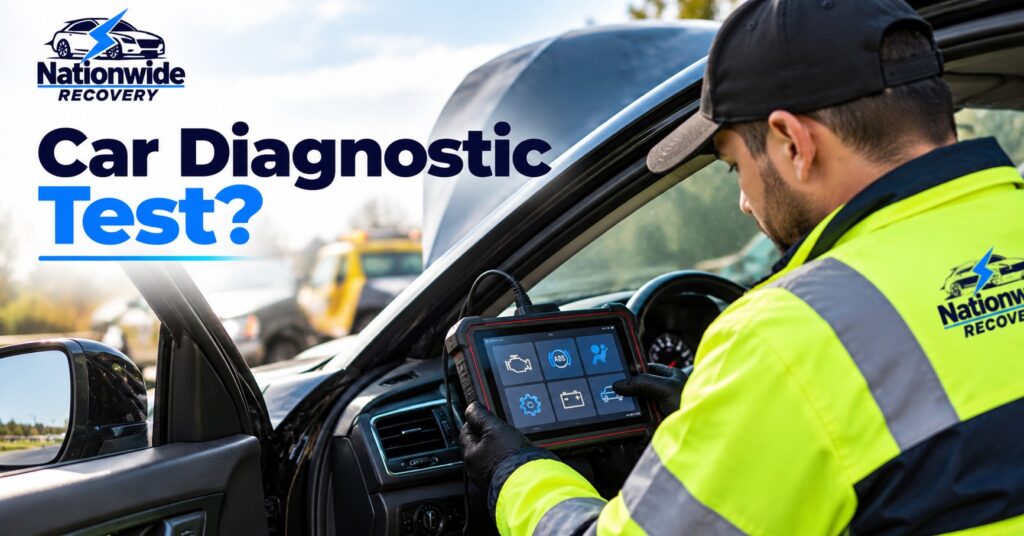
If you are wondering what does a car diagnostic test check, it can inspect electronically monitored systems throughout your vehicle. These include the engine, emissions, transmission, ABS, airbags, electrical systems, sensors, and other control modules.
However, a diagnostic scanner does not magically identify every failed part. It retrieves evidence that helps a technician narrow down the real cause.
Modern vehicles use electronic control units to monitor many vehicle functions. UK vehicle rules also require applicable onboard diagnostic systems to record certain engine-management malfunctions.
This guide explains what a mobile car diagnostic test can check. It also explains fault codes, warning lights, live data, and diagnostic limitations.
What Is a Car Diagnostic Test?
A car diagnostic test is an electronic assessment of systems monitored by your vehicle’s onboard computers. Diagnostic equipment communicates with control modules and retrieves information stored after the vehicle detects an abnormal condition.
The process can reveal diagnostic trouble codes and other useful data. More advanced equipment can also display live readings and module information.
The exact diagnostic coverage depends on the vehicle. It also depends on the diagnostic equipment and software being used.
How Does a Diagnostic Test Work?
A technician usually connects diagnostic equipment to the vehicle’s diagnostic socket. The scanner then communicates with compatible electronic control units inside the vehicle.
The process commonly follows these steps:
- Confirm the vehicle and reported symptoms.
- Connect suitable diagnostic equipment.
- Identify accessible control modules.
- Scan for stored and active faults.
- Review relevant fault codes.
- Check live data when required.
- Compare several related readings.
- Inspect likely wiring or components.
- Explain the likely cause.
- Recommend further testing or repair.
A quick scan and a full diagnosis are not the same thing.
Reading a code may take only minutes.
Finding the actual cause can require considerably more investigation.
What Does a Diagnostic Test Check?
A professional car diagnostic test can check several electronically monitored areas. The exact systems available depend on the make, model, age, and equipment fitted.
The seven most useful areas include:
| System | What Diagnostics May Find | Common Driver Symptom |
| Engine | Misfires, sensor faults, mixture issues | Engine warning light |
| Emissions | EGR, oxygen sensor, DPF-related faults | Emissions warning |
| Transmission | Electronic gearbox faults | Gearbox warning |
| ABS | Wheel-speed or system faults | ABS warning light |
| Airbags | SRS system faults | Airbag warning |
| Electrical systems | Module and circuit faults | Multiple warnings |
| Sensors | Abnormal monitored readings | Poor running or warnings |
A scan is therefore much broader than simply reading an engine light.
Professional equipment may communicate with numerous vehicle modules.
1. Engine and Emissions
Engine diagnostics can identify electronically recorded faults affecting engine management and emissions. This is one of the most common reasons drivers request a diagnostic test.
Possible areas include:
- ignition misfires;
- fuel mixture problems;
- oxygen sensor readings;
- throttle-system faults;
- airflow readings;
- boost-pressure problems;
- coolant temperature sensors;
- crankshaft signals;
- camshaft signals;
- exhaust-related faults;
- EGR system faults;
- DPF-related information.
An engine-management light often appears when the vehicle detects an abnormal monitored condition.
The 2026 DVSA MOT inspection manual includes the engine malfunction indicator lamp within emissions inspection rules.
A malfunction light can therefore matter even when the vehicle still appears to drive normally.
Never assume the illuminated light identifies the failed part.
Further diagnosis should confirm the cause.
2. Transmission and Gearbox
Suitable diagnostic equipment may communicate with the transmission control system. It can retrieve electronically recorded faults from supported automatic and automated gearboxes.
Possible information includes:
- transmission fault codes;
- sensor abnormalities;
- temperature information;
- gear-selection issues;
- communication errors;
- control-module problems.
A gearbox warning does not always mean the gearbox itself needs replacing.
A sensor, wiring fault, electrical supply problem, or control issue can create similar symptoms.
That distinction can prevent unnecessary repair costs.
It is one reason proper diagnosis matters.
3. ABS and Braking Systems
Advanced diagnostics can communicate with the Anti-lock Braking System control unit. It can retrieve faults related to monitored components and circuits.
Possible issues include:
- wheel-speed sensor faults;
- damaged sensor circuits;
- control-unit faults;
- electrical interruptions;
- ABS communication problems;
- stability-control related errors.
The DVSA treats an ABS warning device showing a system malfunction as a major MOT defect.
That makes unexplained ABS warning lights important.
However, a code naming a wheel-speed sensor does not always mean the sensor itself has failed.
HELLA specifically recommends checking associated voltage, fuses, wiring, installation, and live data before replacing some sensors.
A damaged connector or other mechanical issue may produce the same fault.
4. Airbags and Safety Systems
Professional diagnostic equipment may access the Supplemental Restraint System. This includes electronically monitored airbag and restraint functions.
A diagnostic scan may identify:
- airbag system faults;
- seat-belt pretensioner issues;
- occupancy sensor faults;
- wiring problems;
- communication faults;
- historical SRS errors.
An illuminated airbag warning should not be ignored.
The airbag system is safety-critical.
Do not attempt to dismantle airbag components based only on a fault-code description.
Professional investigation is safer.
5. Electrical Systems
A car diagnostic test can help investigate many electronically monitored electrical problems. Modern vehicles rely on multiple networked control modules.
Diagnostics may reveal:
- low-voltage related codes;
- communication failures;
- module faults;
- sensor circuit errors;
- lighting-related faults;
- immobiliser problems;
- charging-system clues;
- network communication errors.
However, diagnostics do not replace electrical testing.
A code may point towards a circuit without showing exactly where the problem exists.
A technician may still need to check:
- battery voltage;
- charging output;
- connectors;
- fuses;
- earth points;
- wiring continuity;
- voltage drops.
This becomes especially important when several warning lights appear together.
Low system voltage can sometimes generate multiple electronic faults.
6. Sensors and Live Data
Live data shows measurements reported by vehicle sensors while systems operate. This information can be more useful than reading a fault code alone.
Depending on the vehicle, available readings may include:
- engine speed;
- coolant temperature;
- throttle position;
- air pressure;
- airflow;
- oxygen sensor readings;
- fuel corrections;
- vehicle speed;
- wheel speeds;
- battery voltage;
- boost pressure.
A technician can compare readings and look for values that appear unrealistic.
For example, one wheel-speed reading may differ significantly from the others.
That does not automatically prove the sensor has failed.
The wiring, sensor mounting, encoder ring, or another component may need checking.
HELLA recommends comparing measured values before replacing suspected sensors.
What Is Freeze-Frame Data?
Freeze-frame data records selected operating conditions when certain faults are stored. It can help explain what the vehicle was doing when the problem occurred.
Information may include:
- engine speed;
- vehicle speed;
- engine load;
- coolant temperature;
- throttle position;
- fuel information.
This can be particularly useful with intermittent problems.
A car might behave normally by the time assistance arrives.
The recorded conditions can still provide useful evidence.
7. Body and Comfort Systems
Professional diagnostic tools may access modules beyond the engine and safety systems. Coverage depends heavily on the vehicle and diagnostic equipment.
Possible systems include:
- central locking;
- electric windows;
- parking sensors;
- lighting;
- climate control;
- immobilisers;
- steering systems;
- tyre pressure monitoring;
- comfort modules.
A basic OBD reader may not access these modules.
Professional multi-system diagnostic equipment usually provides broader coverage.
Ask what level of diagnostic scan is being provided.
This matters when your problem is unrelated to the engine.
What Do Car Fault Codes Mean?
A diagnostic trouble code is a stored identifier for a condition detected by a vehicle system. It directs the diagnostic process towards a particular circuit, system, or monitored condition.
The important point is simple.
A fault code is evidence, not an automatic parts list.
Suppose a code relates to an oxygen sensor signal.
Possible causes could include:
- the sensor;
- wiring;
- a connector;
- an air leak;
- an exhaust leak;
- fuel mixture problems;
- another upstream fault.
Replacing the named sensor immediately could therefore waste money.
Good fault finding combines several pieces of evidence.
Stored vs Current Fault Codes
Not every stored fault means the problem exists right now.
Diagnostic systems can contain different types of information.
Current Fault
A current fault is present during the diagnostic assessment.
It usually deserves immediate investigation.
Stored or Historic Fault
A stored fault occurred previously.
The original problem may still exist intermittently.
It may also have disappeared after an earlier repair.
Pending Fault
A pending code can appear when the vehicle detects an abnormal condition.
The conditions may not yet justify a permanent warning.
These distinctions help technicians understand when the problem happened.
They also help avoid treating every code equally.
Can Diagnostics Find Warning-Light Causes?
Diagnostics can often help investigate why an electronically controlled warning light has appeared. The scan identifies recorded information from the relevant systems.
Common examples include:
- engine management light;
- ABS warning;
- airbag warning;
- stability-control warning;
- gearbox warning;
- tyre-pressure system faults.
Warning lights should not be ignored.
The Highway Code warning-display guidance tells drivers to understand warning displays and investigate warnings that remain illuminated.
Different warning colours can also indicate different urgency.
Always check your vehicle handbook.
Will Diagnostics Turn a Warning Light Off?
A diagnostic tool can often clear stored fault codes and associated warning lights. However, clearing a light does not repair the underlying cause.
If the fault remains, the warning may return.
Useful diagnostic practice involves:
- Reading the codes.
- Recording useful data.
- Identifying the likely cause.
- Testing the suspected area.
- Completing any required repair.
- Clearing appropriate codes.
- Checking whether the fault returns.
Simply deleting a code can also remove useful evidence.
Do not clear codes before investigation without good reason.
What Diagnostics Cannot Check
A diagnostic test does not detect every possible vehicle problem. It mainly accesses systems monitored electronically and available through the diagnostic equipment.
It may not directly identify:
- worn brake pads without electronic monitoring;
- mechanical engine damage;
- worn suspension bushes;
- physical fluid leaks;
- damaged tyres;
- noisy wheel bearings;
- clutch wear;
- internal gearbox wear;
- body damage.
Some of these faults may indirectly trigger recorded information.
Others require physical inspection or mechanical testing.
This distinction also separates diagnostics from an MOT.
GOV.UK states that an MOT checks legal roadworthiness requirements.
It specifically notes that the MOT does not assess the condition of the engine, clutch, or gearbox.
Is an OBD Scan a Full Diagnosis?
No.
An OBD scan retrieves information from vehicle control systems.
A full diagnostic process interprets that information and performs additional testing.
Think of it this way:
| Service | Main Purpose |
| Basic code read | Retrieve available fault codes |
| Multi-system scan | Check several electronic modules |
| Live-data assessment | Evaluate sensor readings |
| Full diagnostic investigation | Confirm the underlying cause |
| Mechanical inspection | Check physical components |
| Roadside assessment | Decide the safest next action |
A cheap code reader can therefore provide useful information.
It cannot replace professional fault finding for complex problems.
Nationwide Recovery Diagnostic Framework
A useful diagnostic process answers four questions.
1. What happened?
Describe the symptoms before assuming a cause.
Examples include:
- engine lost power;
- warning light appeared;
- car would not start;
- engine started misfiring;
- gearbox warning appeared.
2. What did the vehicle record?
The diagnostic scan checks available fault information.
Current and historic codes can provide direction.
3. Does the data support the code?
Relevant live data, electrical checks, and physical inspections help confirm the suspected fault.
One code should not override contradictory evidence.
4. Can the car continue safely?
This is especially important during mobile diagnostics.
The vehicle may need repair or recovery instead.
This four-step approach helps avoid replacing parts based only on one fault code.
What Is a Mobile Car Diagnostic Test?
A mobile car diagnostic test brings diagnostic equipment to the vehicle. The assessment can take place at home, work, or another suitable location.
This can be useful when:
- the car will not start;
- a warning light has appeared;
- the vehicle runs poorly;
- you want an initial fault assessment;
- travelling to a garage may be risky;
- the car has recently broken down.
Nationwide Recovery provides vehicle diagnostic services for different makes and models.
Diagnostics can help determine the next sensible action.
That may involve roadside support, repair, or recovery.
When Should You Get Diagnostics?
Arrange diagnostics when the vehicle develops unexplained electronic or performance symptoms. Early investigation can reduce guesswork about the problem.
Common reasons include:
- engine warning light;
- ABS warning light;
- airbag warning;
- poor engine performance;
- intermittent cutting out;
- unexpected limp mode;
- electrical faults;
- starting problems;
- gearbox warnings;
- repeated fault messages.
If your engine stopped unexpectedly, read our guide about an engine cutting out while driving.
That guide explains safe actions before diagnosis.
Diagnostics or Roadside Assistance?
Diagnostics and roadside assistance solve different problems.
Diagnostics focus on identifying the likely fault.
Roadside assistance focuses on resolving suitable problems where the vehicle has stopped.
| Situation | Likely Next Step |
| Warning light but vehicle remains stable | Diagnostics |
| Unexplained electrical problem | Diagnostics |
| Car will not start | Roadside assessment |
| Flat battery suspected | Jump-start assistance |
| Engine repeatedly cuts out | Diagnostics or recovery |
| Serious warning appears | Stop and assess |
| Vehicle cannot continue safely | Breakdown recovery |
Nationwide Recovery provides 24/7 roadside assistance for suitable roadside problems.
The correct service depends on the symptoms and vehicle condition.
When Is Recovery Better?
Diagnostics may identify the problem without making the vehicle safe to drive. Some faults require workshop repairs or more detailed testing.
Recovery makes more sense when:
- the engine will not run;
- the car repeatedly stalls;
- a serious safety warning appears;
- steering or braking is affected;
- the gearbox will not operate correctly;
- the vehicle cannot move safely.
Nationwide Recovery provides breakdown recovery when a vehicle cannot continue safely.
Do not risk further damage simply to reach a garage.
Mobile Car Diagnostics in Oldham
Nationwide Recovery provides vehicle diagnostics from its Oldham base. The wider service area includes Greater Manchester and surrounding North West locations.
The service can be useful when a warning light appears unexpectedly.
It can also help when your vehicle develops an unexplained running problem.
Nationwide Recovery also provides recovery and roadside support.
That means the next step can be planned around the diagnostic findings.
Does a Warning Light Mean an MOT Failure?
Some warning lights can affect an MOT result.
The exact rules depend on the system and vehicle.
For example, the current DVSA MOT inspection manual includes requirements for applicable engine malfunction indicator lamps.
The DVSA braking inspection rules also classify an ABS warning showing a malfunction as a major defect.
Do not wait until the MOT to investigate an important warning.
Diagnostics may help identify the cause beforehand.
What Should You Tell the Technician?
Good information from the driver can shorten the diagnostic process.
Describe exactly what happened.
Useful information includes:
- warning light shown;
- when it appeared;
- whether it flashes;
- driving conditions;
- recent repairs;
- unusual sounds;
- starting behaviour;
- loss of power;
- whether the problem is intermittent.
Do not tell the technician which part you think needs replacing.
Describe the symptoms instead.
That leaves the diagnosis open to the evidence.
Final Answer
So, what does a car diagnostic test check?
It checks electronically monitored systems and retrieves information recorded by vehicle control modules. Depending on the vehicle, this can include the engine, transmission, emissions, ABS, airbags, sensors, electrical systems, and body electronics.
Professional diagnostic equipment may also show live sensor values.
Some vehicles provide useful freeze-frame information.
However, a fault code does not automatically identify the failed component.
The code tells the technician where to investigate.
Further electrical, mechanical, or visual testing may still be required.
Mobile diagnostics can be especially useful when the car cannot easily reach a garage.
Nationwide Recovery provides vehicle diagnostics alongside roadside assistance and breakdown recovery.
Need a diagnostic check in Oldham or surrounding areas?
📞 Call Nationwide Recovery: 0161 706 0346
📍 Havelock Street, Oldham OL8 1JR
Frequently Asked Questions
Question: What does a car diagnostic test check?
Answer: A car diagnostic test checks electronically monitored systems such as the engine, emissions, ABS, airbags, transmission, sensors, and electrical modules. The exact coverage depends on the vehicle and diagnostic equipment.
Question: Can a diagnostic test tell exactly what is wrong?
Answer: Not always. A diagnostic code usually identifies a system, circuit, or abnormal condition requiring investigation. Additional live-data, electrical, mechanical, or visual checks may be required before identifying the failed component.
Question: Can diagnostics find electrical faults?
Answer: Diagnostics can identify many electronically recorded electrical faults and communication errors. However, technicians may still need multimeter tests, wiring inspections, fuse checks, or voltage-drop testing to find the exact electrical cause.
Question: Can diagnostics check an ABS warning light?
Answer: Professional equipment can often communicate with the ABS control module and retrieve relevant fault information. A technician may then check wheel-speed sensors, wiring, power supplies, or other related components.
Question: Can diagnostics check an airbag light?
Answer: Suitable diagnostic equipment can often retrieve faults stored within the airbag or Supplemental Restraint System. Airbag systems are safety-critical, so repairs should follow professional testing and manufacturer procedures.
Question: Does a diagnostic test clear warning lights?
Answer: Diagnostic equipment can often clear applicable codes and warning lights. However, clearing a warning does not repair the fault. The light may return when the vehicle detects the same problem again.
Question: Can a diagnostic test find every car fault?
Answer: No. Diagnostics mainly identify electronically monitored faults. Mechanical wear, physical damage, fluid leaks, tyres, suspension components, and other problems may require direct inspection or separate testing.
Question: Is a mobile diagnostic test worth it?
Answer: A mobile diagnostic test can be useful when the vehicle cannot easily reach a garage. It may identify the likely fault and help decide whether roadside repair, workshop attention, or recovery is required.