

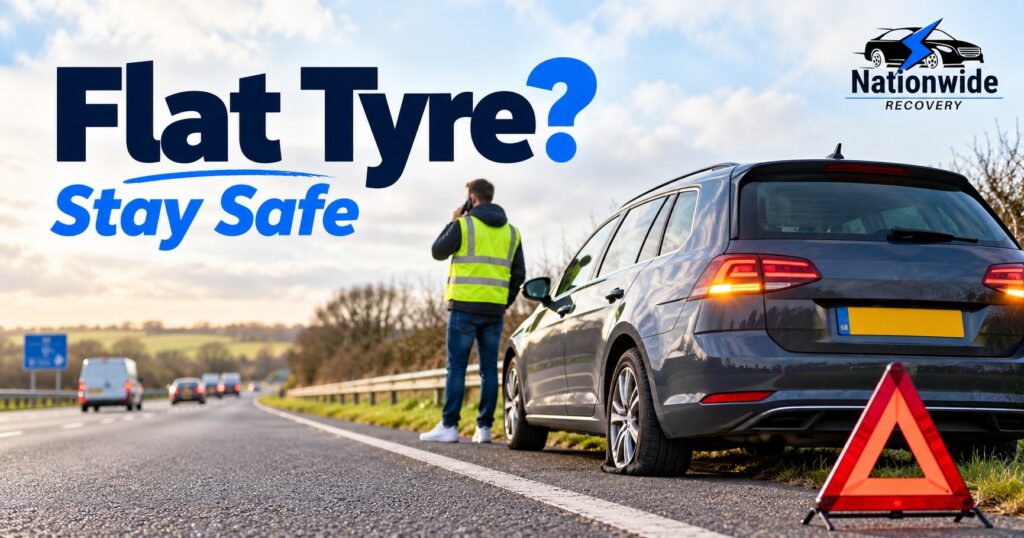
If you have a flat tyre what to do first depends on where the vehicle has stopped. Move to a safer place when possible, use hazard lights when needed, and avoid working beside fast traffic.
Do not keep driving on a visibly flat standard tyre. Continuing can damage the tyre, wheel, and potentially affect vehicle control.
This guide explains the first ten minutes after discovering a flat tyre. It also covers motorways, spare wheels, run-flat tyres, locking wheel nuts, and mobile tyre fitting.
What Should You Do First?
If you suspect a flat tyre, reduce speed smoothly. Avoid sudden steering, braking, or acceleration.
Move towards a safe stopping place when possible. Your first priority is getting away from moving traffic.
Once stopped:
- Apply the parking brake.
- Switch the engine off where appropriate.
- Use hazard lights if needed.
- Keep passengers away from traffic.
- Assess the location before leaving the vehicle.
- Inspect the tyre only when safe.
Do not focus on tyre repair while the vehicle remains exposed. Safety comes before diagnosis.
Can You Drive With a Flat Tyre?
You should not continue normal driving on a visibly flat standard tyre. The tyre may no longer support the vehicle correctly.
Driving can damage:
- the tyre sidewall;
- internal tyre structure;
- the wheel rim;
- valve components.
Vehicle handling can also become unpredictable. Stop somewhere safer as soon as conditions allow.
The exception may involve certain run-flat tyres. Even then, manufacturer limits must be followed.
Check the Tyre Safely
Only inspect the tyre when the vehicle is fully away from dangerous traffic. Look for obvious signs without crawling underneath the vehicle.
Check for:
- a nail or screw;
- cuts;
- sidewall bulges;
- torn rubber;
- damaged valve;
- completely lost pressure;
- visible wheel damage.
Do not remove an embedded object. It may be slowing the air leak.
A puncture location matters. Some damage can be repaired, while other damage requires replacement.
What If the Tyre Loses Pressure Slowly?
A gradual flat tyre can be caused by several problems. These include a puncture, leaking valve, damaged wheel, or sealing issue.
Repeatedly adding air is not a permanent repair. The cause should be inspected.
A slow puncture can become a complete flat unexpectedly. Deal with repeated pressure loss before a longer journey.
Flat Tyre on a Motorway
A motorway flat tyre requires a different approach. Do not attempt to change the wheel beside high-speed traffic.
The Highway Code recommends leaving at the next exit or entering a service area where possible. Otherwise, move left into an emergency area or hard shoulder.
If you reach a safer position:
- switch on hazard lights;
- stop as far left as possible;
- exit away from traffic when safe;
- move behind a barrier where available;
- keep passengers away from the carriageway;
- contact professional assistance.
Never place a warning triangle on a motorway. Do not attempt a roadside tyre change in an exposed motorway position.
If you cannot reach a safer place or exit safely, remain inside. Keep seatbelts fastened and call 999.
Read Nationwide Recovery’s motorway breakdown guide for fuller motorway guidance.
Should You Change the Tyre Yourself?
Changing a wheel may be possible in a safe, level location. It should not be attempted where traffic creates danger.
Before considering a wheel change, confirm that you have:
- a suitable spare;
- vehicle jack;
- wheel brace;
- locking wheel nut key;
- safe level ground;
- knowledge of the manufacturer’s procedure.
Do not crawl underneath a vehicle supported only by a jack. Never improvise when the ground is unstable.
If the location is unsafe, request mobile tyre assistance instead.
What If Your Car Has No Spare?
Many modern cars do not include a full spare wheel. They may provide a tyre repair kit instead.
Other vehicles may use:
- temporary space-saver spare;
- sealant kit;
- compressor;
- run-flat tyres.
Check the vehicle handbook before using any kit. Sealant products have limits and cannot repair every puncture.
Sidewall damage, large holes, or severe tyre damage usually need different assistance. Mobile replacement may be more suitable.
Can a Flat Tyre Be Repaired?
Some punctures can be repaired professionally. Others require the tyre to be replaced.
Repairability depends on factors including:
- puncture position;
- puncture size;
- tyre condition;
- previous repairs;
- internal damage;
- sidewall condition.
A puncture in the main tread area may sometimes be repairable. Sidewall damage is generally more serious.
Do not assume a tyre is repairable from the outside. Internal inspection may be required.
What About Sidewall Damage?
Sidewall damage deserves particular caution. The sidewall flexes constantly while the vehicle moves.
Look for:
- cuts;
- bulges;
- exposed cords;
- cracking;
- impact damage.
Do not continue driving on a tyre with serious sidewall damage. Replacement is usually the safer outcome.
A pothole impact can damage both tyre and wheel. Steering or suspension may also need inspection.
What About Run-Flat Tyres?
Run-flat tyres can support limited driving after pressure loss. Their exact limits depend on the tyre and vehicle manufacturer.
Do not assume every flat tyre is a run-flat. Check the tyre markings and vehicle handbook.
Even with run-flats, speed and distance limits usually apply. Damage severity can also change what is safe.
If the tyre has suffered major damage, stop. Professional assistance may still be required.
What Is the Legal Tyre Tread Depth?
Most UK cars need at least 1.6 mm tread depth. It must cover the central three-quarters of the tread.
The legal tread must continue around the tyre circumference. Tyres must also remain free from dangerous defects.
A legal tyre can still need replacement after severe puncture damage. Tread depth is only one part of tyre condition.
GOV.UK also requires drivers to maintain correct tyre pressures. Use the manufacturer’s specification for your vehicle.
Why the Locking Wheel Nut Matters
A locking wheel nut can delay roadside tyre replacement. The correct key is needed to remove the protected wheel bolt.
Drivers often discover the key is missing only after a puncture. Check its location before an emergency.
Common storage places include:
- glovebox;
- boot floor;
- spare-wheel compartment;
- vehicle tool kit.
Tell the tyre provider if the key is missing. This helps them plan the correct equipment.
What Information Does Mobile Tyre Help Need?
Giving accurate information can make assistance easier. Tell the provider what has happened and where the vehicle is located.
Useful details include:
- exact location;
- direction of travel;
- registration number;
- make and model;
- tyre size;
- damaged wheel position;
- whether the tyre is completely flat;
- whether you have a locking wheel nut key.
Tyre size is written on the tyre sidewall. A common format looks similar to 205/55 R16.
Do not guess the size. Send a clear photograph when possible.
What Does Mobile Tyre Fitting Do?
Mobile tyre fitting brings tyre equipment directly to the vehicle. It can be useful at home, work, or a safe roadside location.
Nationwide Recovery’s mobile tyre service supports punctures, replacements, and tyre fitting.
Depending on the situation, the technician may assess:
- tyre condition;
- wheel condition;
- repairability;
- replacement needs;
- tyre size;
- safe fitting location.
The service avoids driving a damaged tyre to a garage. That can prevent additional wheel or tyre damage.
Mobile Tyre Help or Roadside Assistance?
Different situations need different services. Use the vehicle’s condition to choose.
| Situation | Likely Next Step |
| Repairable puncture in safe location | Mobile tyre assistance |
| Tyre needs replacement | Mobile tyre fitting |
| Flat battery as well | Roadside assistance |
| Unknown vehicle problem | Roadside assessment |
| Vehicle cannot be moved safely | Breakdown recovery |
| Unsafe motorway location | Safety first, then recovery |
Nationwide Recovery also provides roadside assistance for broader breakdown situations.
Do not book a generic service without explaining the tyre problem. Accurate details help the right equipment reach you.
When Is Recovery Better?
Mobile tyre fitting is not suitable in every location. Recovery may be safer when the vehicle cannot be worked on safely.
Examples include:
- dangerous motorway position;
- damaged wheel or suspension;
- multiple damaged tyres;
- severe collision damage;
- vehicle cannot move normally;
- specialist equipment is required.
In those cases, breakdown recovery can move the vehicle.
Do not risk driving a seriously damaged tyre just to reach a tyre shop. Transport can prevent further damage.
What If the Tyre Goes Flat at Night?
A night-time flat tyre creates additional visibility risks. Move to a well-lit safer location if the vehicle can reach one safely.
Use appropriate vehicle lights. Keep yourself and passengers away from traffic.
Do not begin a wheel change simply because the road appears quiet. Approaching drivers may see you late.
Wear reflective clothing if available. Keep your phone charged while waiting for assistance.
How Can You Prevent Another Flat?
Not every puncture can be avoided. Regular tyre checks can still reduce preventable roadside problems.
Check:
- tyre pressure;
- tread depth;
- sidewall damage;
- embedded objects;
- valve condition;
- uneven wear.
GOV.UK says drivers are responsible for keeping vehicles roadworthy. Tyres should be correctly inflated and free from dangerous defects.
Check tyres before long journeys. Do not wait for the pressure warning to appear.
Flat Tyre Help in Oldham
Nationwide Recovery provides mobile tyre help across Oldham and surrounding Greater Manchester areas. The service is available for drivers at home, work, or accessible roadside locations.
Coverage includes Manchester, Rochdale, Tameside, Stockport, Trafford, Bolton, Wigan, and nearby areas.
For a faster assessment, provide the exact location and tyre size. Also mention whether the vehicle is safely parked.
The current contact number is 0161 706 0346. Assistance is available around the clock.
Final Answer
If you have a flat tyre what to do first is simple. Get the vehicle and passengers away from moving traffic before inspecting the tyre.
Do not continue normal driving on a visibly flat standard tyre. This can damage both the tyre and wheel.
If the location is safe, check whether you have a usable spare or approved repair kit. Follow the vehicle manufacturer’s instructions.
Do not attempt a tyre change beside exposed motorway traffic. Arrange professional help instead.
Nationwide Recovery provides mobile tyre fitting, roadside assistance, and breakdown recovery across Oldham and Greater Manchester.
Need tyre help now?
📞 Call Nationwide Recovery: 0161 706 0346
🌐 Nationwide Recovery Mobile Tyres
📍 Havelock Street, Oldham OL8 1JR
Frequently Asked Questions
Question: What should I do first with a flat tyre?
Answer: Reduce speed smoothly and move towards a safer stopping place. Use hazard lights when needed. Do not inspect or change the tyre while exposed to moving traffic.
Question: Can I drive with a flat tyre?
Answer: Do not continue normal driving on a visibly flat standard tyre. Driving can damage the tyre and wheel. Run-flat tyres have separate manufacturer limits.
Question: Can I change a tyre beside the road?
Answer: Only consider it in a safe, level location away from traffic. Do not attempt a wheel change where passing vehicles create danger. Motorways require extra caution.
Question: What should I do with a flat tyre on a motorway?
Answer: Leave at the next exit or reach a service area when possible. Otherwise, move left towards an emergency area. Never change the tyre beside exposed motorway traffic.
Question: What if my car has no spare tyre?
Answer: Check for a manufacturer-supplied repair kit or run-flat system. These options have limitations. Mobile tyre fitting may be the safest solution for many punctures.
Question: Can a punctured tyre be repaired?
Answer: Some tread-area punctures may be repairable after professional inspection. Sidewall damage, severe damage, or unsuitable punctures often require replacement instead.
Question: Do I need my locking wheel nut key?
Answer: Yes, if the affected wheel uses a locking wheel nut. Keep the correct key accessible. Tell the tyre provider beforehand if the key is missing.
Question: What tyre tread depth is legal in the UK?
Answer: Most UK cars require at least 1.6 mm across the central three-quarters. The legal tread must continue around the entire tyre circumference.