

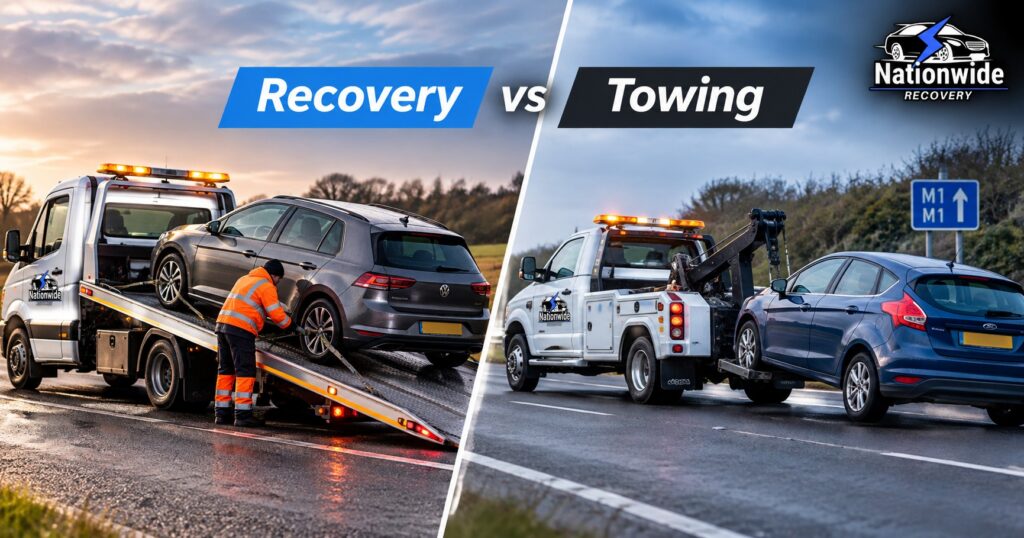
Car recovery vs towing comes down to scope: towing describes moving a vehicle, while car recovery is the wider response to a disabled, damaged, or immobilised vehicle and may include towing. In practice, UK drivers often hear both terms together because recovery frequently ends with vehicle transportation.
National Highways says its traffic officers deal with more than 85,000 breakdowns each year on England’s motorways and major A-roads. It also reported that tyre issues caused 19% of recorded breakdowns during 2025.
This guide is for drivers deciding what type of vehicle assistance to request. It compares the process, cost factors, response, equipment, and provider selection.
Nationwide Recovery provides breakdown recovery, roadside assistance, and vehicle towing across the UK.
Car Recovery vs Towing: Key Difference
Car recovery is the broader service used when a vehicle needs professional assistance after becoming disabled or immobilised. Towing describes the actual movement of a vehicle between locations.
This means towing can be part of a car recovery job.
For example, your car may stop because of a mechanical issue. A recovery operator assesses the situation before arranging transportation to your chosen garage.
Another driver may already know that a working vehicle needs transporting between two locations. That situation may simply require a towing or vehicle transport service.
The words often overlap in everyday UK use.
Even major breakdown providers sometimes describe vehicle recovery as a towing service. Therefore, drivers should focus on the required service rather than terminology alone.
What Is Car Recovery?
Car recovery is a service for vehicles that cannot continue their journey normally. It can include roadside assessment, vehicle positioning, loading, extraction, and transportation to an agreed destination.
The exact recovery method depends on the vehicle and situation.
Common car recovery situations include:
- mechanical breakdowns;
- vehicles that will not start;
- accident-damaged vehicles;
- vehicles with locked wheels;
- steering problems;
- vehicles requiring transportation;
- vehicles positioned where additional equipment is needed.
A straightforward breakdown may only need roadside assistance.
If the vehicle cannot continue, professional recovery can transport it to a garage, home, dealership, or another agreed destination.
The Driver and Vehicle Standards Agency uses several specific classifications for recovery vehicles and operations. Therefore, the legal meaning can be more detailed than everyday customer terminology.
What Is Vehicle Towing?
Vehicle towing is the process of moving a vehicle using suitable towing or transportation equipment. The vehicle normally travels from its collection point to an agreed destination.
Towing can be used after a breakdown.
However, the vehicle does not always need to have broken down.
A driver might request vehicle towing services when moving a vehicle between locations.
Typical examples include:
- transporting a non-running car;
- taking a vehicle to a garage;
- moving a vehicle to another address;
- transporting a recently purchased vehicle;
- moving a vehicle for planned maintenance;
- completing the transport stage after recovery.
Therefore, towing describes the transportation task more specifically.
Recovery describes the wider assistance required around an immobilised vehicle.
Recovery vs Towing Comparison
The easiest way to understand car recovery vs towing is to compare what happens during each service.
| Factor | Car Recovery | Vehicle Towing |
| Main purpose | Assist a disabled or immobilised vehicle | Move a vehicle between locations |
| Vehicle issue required | Usually linked to a breakdown or incident | Not always |
| Roadside assessment | May be required | Usually not the main purpose |
| Repositioning | Can form part of recovery | May be needed before loading |
| Vehicle transport | Often included | Main service |
| Destination | Garage, home, dealership, or agreed location | Agreed collection and delivery points |
| Equipment | Selected around vehicle condition | Selected around transport requirements |
| Quote factors | Condition, access, distance, equipment | Distance, vehicle, access, equipment |
| Response priority | Often time-sensitive | Can be urgent or planned |
| Best information to provide | Location, condition, vehicle, destination | Collection, vehicle, destination |
The important distinction is purpose.
Recovery begins with the vehicle’s situation.
Towing begins mainly with the need to move the vehicle.
Which Service Do You Need?
Choose recovery when your vehicle has stopped unexpectedly and you need assistance deciding the safest next step. Choose towing when the main requirement is transporting the vehicle from one known location to another.
Use this simple selector.
Choose Car Recovery When
Your vehicle has stopped and you are unsure whether it can continue.
You may also need recovery when:
- the engine will not restart;
- the vehicle cannot move normally;
- the vehicle has accident damage;
- one or more wheels cannot rotate;
- the steering is affected;
- the vehicle requires repositioning before transport.
The recovery operator can use the information you provide to plan suitable assistance.
Choose Towing When
You already know that the vehicle needs transportation.
Typical situations include:
- taking a non-running vehicle to a garage;
- moving a vehicle between addresses;
- transporting a vehicle for repair;
- arranging planned vehicle movement.
Towing can also follow a roadside recovery assessment.
The two services therefore work together rather than competing with each other.
The 60-Second Service Selector
Drivers can use this simple decision path before calling:
Can the vehicle continue normally?
Yes → You may not need transportation.
No → Does the vehicle need roadside help first?
Yes → Request recovery or roadside assistance.
No → Do you already know where the vehicle needs transporting?
Yes → Request towing or vehicle transport.
If you are unsure, explain the vehicle’s condition when calling.
A professional provider can then arrange the most suitable response.
How Does the Process Differ?
Car recovery usually starts by understanding why the vehicle cannot continue. Towing normally starts with confirming the collection point, destination, vehicle details, and transportation requirements.
Both processes become quicker when accurate information is available.
Car Recovery Process
A typical recovery request follows these steps:
- Share your exact location.
- Provide the vehicle registration.
- Explain what happened.
- Describe the vehicle’s current condition.
- Confirm whether the wheels and steering operate.
- Provide your required destination.
- Confirm the proposed recovery method.
- Receive the complete quotation.
- A suitable recovery vehicle is dispatched.
- Your vehicle is assisted or transported.
Vehicle Towing Process
A planned towing request usually follows a simpler path:
- Provide the collection postcode.
- Give the vehicle make and model.
- Describe its current condition.
- Confirm access at the collection point.
- Provide the destination postcode.
- Confirm transportation requirements.
- Agree the quote and schedule.
- The vehicle is collected and transported.
The final transport stage can look similar.
The main difference comes before transportation begins.
How Do Costs Compare?
Neither recovery nor towing has one fixed UK price. The final quote depends on distance, vehicle type, condition, access, response requirements, and equipment.
Recovery can involve more stages before transportation.
For example, the operator may need to assess or reposition an immobilised vehicle before loading it.
A straightforward towing job may already have clear collection and destination details.
However, towing distance can become a major pricing factor on longer journeys.
Common quote factors include:
| Cost Factor | Why It Matters |
| Distance | Determines transportation mileage |
| Vehicle size | Influences suitable recovery capacity |
| Vehicle condition | Can affect loading requirements |
| Wheel movement | May influence equipment selection |
| Collection access | Helps determine the recovery approach |
| Destination | Sets the required journey |
| Timing | Influences current availability |
| Equipment | Must match the specific vehicle |
Do not compare services using only a headline towing rate.
Instead, ask for the complete quote for your actual vehicle and journey.
For detailed UK price guidance, read our car recovery cost UK guide.
Is Recovery More Expensive Than Towing?
Recovery can involve additional work when a vehicle needs assessment, repositioning, or specialist handling before transportation. However, a simple recovery and a straightforward tow can sometimes involve very similar work.
Distance also changes the comparison.
A longer towing journey can involve more transportation time than a short local recovery.
Vehicle type matters too.
Larger vehicles may require different equipment regardless of whether the booking is called recovery or towing.
Therefore, compare the complete job rather than the service name alone.
Which Service Responds Faster?
Response time depends mainly on your location, road conditions, vehicle requirements, and the nearest suitable recovery unit. Calling the service “towing” or “recovery” does not automatically make one faster.
Urgent roadside situations usually require prompt dispatch.
Planned towing can often be scheduled around a preferred collection time.
At Nationwide Recovery, the booking process begins with your location and vehicle details.
This helps identify what assistance and equipment the job requires.
Providing accurate details can reduce unnecessary back-and-forth during dispatch.
What Equipment Is Used?
The equipment depends on the vehicle’s size, condition, position, and transportation requirements. Professional recovery operators select a suitable method after understanding the actual job.
Recovery vehicles can use loading, lifting, winching, or transport equipment.
The precise setup varies between vehicles.
DVSA guidance also places specific requirements on road-recovery vehicles and towing operations.
For example, vehicle weights and recovery methods can affect which rules apply.
This is another reason to provide the exact vehicle make and model.
The operator also needs to know whether the vehicle rolls, steers, and selects neutral.
Can Roadside Assistance Avoid Towing?
Yes, some vehicle problems can be resolved through roadside assistance without transporting the vehicle. If the vehicle can return to normal operation, towing may not be required.
Suitable roadside services can include help with:
- certain battery problems;
- jump starts;
- suitable tyre issues;
- minor roadside faults;
- initial vehicle assessment.
If the vehicle still cannot continue normally, recovery or towing becomes the next stage.
This creates a simple sequence:
Roadside assistance → assess or assist → continue driving or recover the vehicle
Nationwide Recovery provides roadside assistance alongside towing and recovery.
That allows the service to match the vehicle’s actual situation.
What About Motorway Breakdowns?
A motorway breakdown should be treated as a roadside safety situation before deciding between recovery and towing. Move towards a place of relative safety when possible and arrange professional assistance.
The Highway Code says drivers should try to get their vehicle off the road where possible.
On motorways, a service area is considered safer than stopping beside live traffic.
The Highway Code also advises contacting a breakdown recovery service when help is required.
If your vehicle stops in a live lane and you cannot reach safety, call 999.
Do not focus on choosing service terminology while immediate safety needs attention.
Once safe, explain the situation clearly to the recovery provider.
They can determine what vehicle and equipment should attend.
Can You Tow a Car Yourself?
UK guidance recommends careful consideration before using another car to tow a disabled vehicle. Professional recovery is usually more suitable when safe transportation requires dedicated equipment.
The Highway Code states that towing with a rope can create additional hazards.
It advises considering a solid tow bar or professional recovery instead.
Vehicle weight, braking, steering, road type, and towing equipment all matter.
Motorways and high-speed roads also create different safety considerations.
For most drivers, calling a professional provider simplifies the process.
It also ensures the required vehicle details can be assessed before movement.
How to Choose a Recovery Provider
Choose a provider that can clearly explain the response, equipment, destination, and complete quote for your vehicle. The provider should understand your actual situation before dispatching a recovery vehicle.
Use these questions before booking.
1. Can You Handle My Vehicle?
Provide the exact make and model.
Also mention whether it is a car, van, SUV, 4×4, motorcycle, or electric vehicle.
2. What Information Do You Need?
A professional booking process should collect the key recovery details.
These include location, condition, access, and destination.
3. What Is the Response Estimate?
Ask for the current arrival estimate for your location.
Traffic and vehicle availability can affect response times.
4. What Does the Quote Include?
Confirm the complete service.
Ask whether collection, loading, transport, and destination are covered.
5. Where Will My Vehicle Go?
Confirm your chosen destination before dispatch.
This may be your home, garage, dealership, or specialist repairer.
Nationwide Recovery Booking Checklist
When contacting Nationwide Recovery, prepare four key details:
LOCATION → VEHICLE → CONDITION → DESTINATION
Location
Share an accurate postcode or map location.
For major roads, provide your direction and nearest junction where possible.
Vehicle
Provide your registration, make, and model.
These details help identify suitable equipment.
Condition
Explain whether the vehicle starts, rolls, steers, and selects neutral.
Mention any accident damage or unusual vehicle position.
Destination
Tell the team where the vehicle needs to go.
A destination postcode helps establish the complete journey.
This information helps determine whether you need roadside assistance, recovery, towing, or a combination.
Car Recovery Across Greater Manchester
Nationwide Recovery provides vehicle assistance across Oldham, Manchester, and surrounding parts of Greater Manchester.
Coverage also extends across the North West and wider UK for suitable recovery journeys.
Services include:
- breakdown recovery;
- roadside assistance;
- vehicle towing;
- accident recovery;
- vehicle transport;
- jump-start assistance.
The exact response depends on your vehicle and location.
Providing your current location helps the team identify the appropriate next step.
Need Recovery or Towing?
If you are still comparing car recovery vs towing, you do not need to diagnose the service yourself.
Tell Nationwide Recovery where you are, what vehicle you have, and what has happened.
If the vehicle needs wider roadside assistance, the team can assess the recovery requirement.
If transportation is already the clear requirement, vehicle towing can be arranged to an agreed destination.
Call Nationwide Recovery: 0161 706 0346
Have these details ready:
- current location;
- vehicle registration;
- make and model;
- current vehicle condition;
- destination postcode.
Final Summary
Car recovery vs towing is mainly a difference in scope. Towing focuses on moving a vehicle, while recovery deals with the wider situation surrounding a disabled or immobilised vehicle.
A recovery job may end with towing.
A towing job can also be arranged independently when transportation is the main requirement.
For drivers, the practical decision is simple.
Choose based on:
- what happened to the vehicle;
- whether it can move normally;
- where it is located;
- where it needs to go;
- what equipment is required;
- the complete quote;
- the current response estimate.
Nationwide Recovery provides 24/7 vehicle assistance across Greater Manchester, the North West, and wider UK locations.
Call Nationwide Recovery: 0161 706 0346
Frequently Asked Questions
Question: What is the difference between car recovery and towing?
Answer: Towing mainly describes moving a vehicle from one location to another. Car recovery is the wider assistance provided when a vehicle becomes disabled or immobilised. Recovery may include assessment, repositioning, loading, and towing, depending on the vehicle’s condition and location.
Question: Is car recovery the same as towing?
Answer: Car recovery and towing overlap, but they are not always identical in everyday service terms. Towing specifically relates to vehicle transportation. Recovery starts with the vehicle’s situation and can include several steps before transportation becomes necessary.
Question: Do I need recovery or towing?
Answer: Request recovery when your vehicle has stopped unexpectedly and you need professional assistance with the situation. Request towing when you already know the vehicle simply needs transporting between two locations. If unsure, describe the vehicle’s condition to the provider.
Question: Is recovery more expensive than towing?
Answer: The service name alone does not determine the price. Recovery costs can reflect vehicle condition, access, equipment, and transportation distance. Towing quotes also depend on distance, vehicle size, access, and required equipment, so compare the complete job-specific quote.
Question: Does breakdown recovery include towing?
Answer: Breakdown recovery can include towing when the vehicle cannot continue its journey. Some roadside issues may be resolved without transportation. If the vehicle still cannot proceed, it can be recovered to a garage, home, or another agreed destination.
Question: Can a tow truck recover a broken-down car?
Answer: A suitable recovery or towing vehicle can transport many broken-down cars. The required method depends on the vehicle’s weight, condition, wheel movement, access, and position. Providing these details helps the operator select appropriate equipment before dispatch.
Question: Which is faster, towing or recovery?
Answer: Response time depends more on location, traffic, vehicle condition, and equipment availability than the service name. An accurate location and clear vehicle details help the provider identify a suitable recovery unit and provide a more useful arrival estimate.
Question: What details should I give a recovery company?
Answer: Provide your exact location, registration, vehicle make and model, current condition, and required destination. Explain whether the vehicle starts, rolls, steers, or has restricted access. These details help the provider plan an appropriate recovery or towing response.