
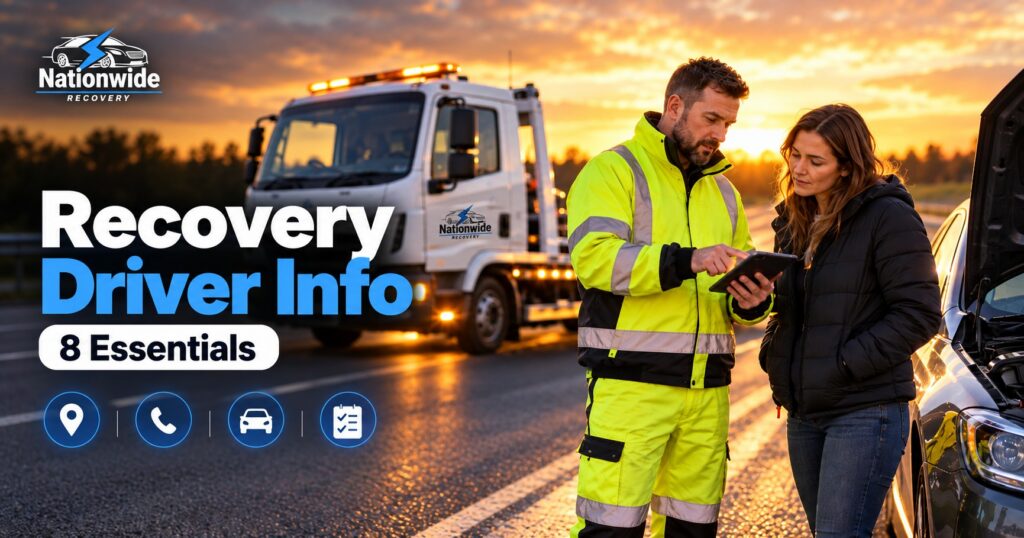
What information does a recovery driver need before dispatch? They usually need your exact location, vehicle details, current condition, access, destination, contact details, and any loading information. Giving these details early helps the recovery team select suitable equipment, prepare your quote, and plan the response.
National Highways says its traffic officers deal with more than 85,000 breakdowns each year. More than 40% involve fuel, tyre maintenance, power loss, or engine trouble.
For drivers arranging professional recovery, clear information can make the booking process much simpler. Nationwide Recovery uses key vehicle and journey details to understand what assistance is required before dispatch.
This guide explains what to prepare, why each detail matters, and how to request recovery efficiently.
What Information Does Recovery Need?
A recovery driver needs enough information to locate you, identify the vehicle, understand its condition, choose suitable equipment, and confirm the destination.
The core information can be remembered as:
LOCATION → VEHICLE → CONDITION → ACCESS → DESTINATION → CONTACT
The table below shows why each detail matters.
| Information | What to Provide | Why It Matters |
| Location | Road, postcode, junction, map pin | Helps the driver find you |
| Vehicle | Registration, make, model | Helps identify vehicle requirements |
| Condition | What happened and current mobility | Supports equipment selection |
| Access | Parking, barriers, road position | Helps plan collection |
| Destination | Full destination or postcode | Helps plan distance and quote |
| Contact | Working mobile number | Keeps communication open |
| Extra details | Keys, neutral, wheels, photos | Helps prepare for loading |
You do not need to diagnose the exact fault.
Describe what happened and what the vehicle can currently do.
1. Your Exact Location
Your exact location is usually the first information a recovery provider needs. Give the clearest safe location available, including your road, postcode, direction, junction, or map pin.
Avoid relying only on a general town or area name.
For example, provide:
- road name or number;
- postcode;
- current map location;
- nearest junction;
- nearby landmark;
- service station;
- car park name;
- direction of travel.
Your location helps the dispatcher identify the best approach to your vehicle.
It can also improve the accuracy of the response estimate.
What If You Do Not Know?
Open your phone’s map application if you can do so safely.
You can share a dropped pin or live location.
On major roads, look for the nearest junction or service area.
Do not walk into moving traffic to find location information.
2. Vehicle Details
Give the recovery provider your registration, make, model, and vehicle type. These details help identify the vehicle and select suitable recovery capacity.
The basic information should include:
- registration number;
- manufacturer;
- model;
- approximate vehicle type;
- fuel or power type.
For example:
“Ford Focus, registration AB12 CDE, petrol hatchback.”
This is much more useful than simply saying you have a car.
Why Registration Helps
The registration gives the recovery company another clear identifier.
It also helps the driver recognise the correct vehicle on arrival.
Make and model information provides useful context about vehicle size and handling requirements.
If you drive a larger vehicle, mention that during the first call.
3. Vehicle Condition
Explain what happened and what the vehicle can currently do. The recovery driver does not need you to diagnose the exact mechanical cause before dispatch.
Describe the symptoms you observed.
Useful examples include:
- engine will not start;
- engine stopped while driving;
- vehicle lost power;
- battery appears flat;
- tyre is damaged;
- warning light appeared;
- vehicle overheated;
- steering feels different;
- wheel will not rotate;
- vehicle has accident damage.
Simple observations are often more useful than a technical guess.
For example, say:
“The engine turns over but does not start.”
That gives the operator clear information about the current condition.
If your vehicle has stopped unexpectedly, Nationwide Recovery’s breakdown recovery service can assess the information before arranging assistance.
4. Road Position and Access
Tell the recovery provider exactly where the vehicle is positioned and whether there are any access restrictions. Access can influence the recovery vehicle and loading approach required.
A vehicle on an open residential road may have straightforward access.
A vehicle inside a restricted car park can require different planning.
Tell the operator if your car is:
- on a driveway;
- inside a car park;
- underground;
- beside a barrier;
- on a narrow road;
- on a verge;
- positioned on a slope;
- close to a wall;
- behind a locked gate;
- partly off-road.
Also mention height limits where relevant.
This allows the dispatcher to consider access before sending a recovery vehicle.
5. Keys, Wheels and Neutral
A recovery driver should know whether the vehicle has keys and whether it can roll, steer, brake, and select neutral. These details can directly affect how the vehicle is loaded.
Before calling, check what you already know.
Tell the operator:
- whether the keys are available;
- whether the steering operates;
- whether the wheels rotate;
- whether the vehicle selects neutral;
- whether the handbrake releases;
- whether any wheel is damaged;
- whether the suspension appears affected.
You do not need to test a vehicle in an unsafe position.
Simply explain what you know.
Why Wheel Movement Matters
A vehicle that rolls normally can have different loading requirements from one with locked wheels.
The same applies to steering.
Providing this detail before dispatch gives the recovery provider more information for planning.
Nationwide Recovery also offers vehicle towing services when a vehicle needs professional transportation.
6. Your Destination
Tell the recovery company where you want the vehicle taken. A confirmed destination helps establish the journey distance and complete recovery requirement.
Common destinations include:
- your home;
- local garage;
- dealership;
- specialist workshop;
- body repair centre;
- secure storage location;
- another agreed address.
Provide the complete postcode where possible.
Also confirm that the destination can receive the vehicle.
Why Destination Matters Early
Destination affects several parts of the recovery plan.
It can influence:
- journey mileage;
- travel time;
- quote preparation;
- route planning;
- booking schedule.
Changing the destination later can alter the journey.
Therefore, confirm it before dispatch whenever possible.
7. Contact and Passenger Details
Provide a working mobile number and tell the recovery company how many people are with the vehicle. Good contact information helps the driver communicate during the journey to you.
Keep your phone available after confirming the booking.
The driver may need to:
- confirm your position;
- advise that they are approaching;
- clarify access;
- confirm the vehicle;
- update the arrival estimate.
If you move the vehicle before the driver arrives, tell the recovery company.
The same applies if another road authority moves it.
Tell Them About Passengers
Mention how many people are travelling with you.
This is useful because passenger arrangements can depend on the recovery vehicle and service.
Also mention relevant accessibility requirements when arranging assistance.
8. Photos and Extra Information
Safe photographs can help a recovery provider understand unusual vehicle positions, visible damage, or restricted access. Photos should only be taken when doing so is safe.
Useful photographs may show:
- vehicle position;
- damaged wheel;
- visible accident damage;
- road access;
- low clearance;
- parking restrictions;
- warning message on the dashboard.
A wide image can sometimes explain access better than a long description.
However, never enter traffic or an unsafe area just to take a photograph.
Useful Additional Information
Depending on the situation, also mention:
- vehicle modifications;
- very low suspension;
- missing wheels;
- heavy contents;
- trailer attached;
- roof box;
- unusual dimensions;
- parking restrictions.
Each detail helps build a clearer picture before attendance.
How Details Affect Response
Complete recovery information helps the dispatcher understand the job before selecting a recovery vehicle. Location, vehicle condition, access, and equipment requirements can all affect the response plan.
Consider two example calls.
Call One
“My car has broken down in Manchester.”
This gives only limited information.
Call Two
“My Ford Focus will not restart. I am safely parked near the M60, junction 23. The car rolls and steers. I need recovery to my garage in Oldham.”
The second call gives the dispatcher much more useful information.
It covers:
- vehicle;
- condition;
- location;
- mobility;
- destination.
That makes the recovery requirement easier to understand.
How Details Affect Cost
Recovery quotes normally depend on the complete job rather than one detail alone. Distance, vehicle type, condition, access, and required equipment can all influence the final quotation.
Providing clear information can help the provider prepare a more relevant quote.
Important quote factors include:
| Factor | Possible Impact |
| Pickup location | Travel and access |
| Destination | Recovery mileage |
| Vehicle size | Recovery capacity |
| Vehicle condition | Loading method |
| Wheel movement | Equipment requirement |
| Access | Collection method |
| Timing | Current availability |
| Special requirements | Equipment planning |
For broader pricing information, read our UK car recovery cost guide.
Before booking, ask:
“Is this the complete quote for collecting my vehicle and taking it to the agreed destination?”
This keeps the recovery arrangement clear.
What Information Is Needed on a Motorway?
For motorway recovery, provide the motorway number, direction of travel, nearest junction, service area, emergency area, or another safe location marker. Your exact carriageway direction is especially important.
For example:
“M62 westbound, near junction 20.”
That is much more useful than:
“I’m somewhere on the M62.”
Motorways can cover long distances.
Opposite carriageways can also require different approaches.
Give These Details
Where safely available, provide:
- motorway number;
- direction of travel;
- nearest junction;
- service area;
- emergency-area reference;
- safe map pin;
- vehicle registration;
- vehicle condition.
The current Highway Code says motorists should try to reach a place of relative safety after a breakdown.
It also advises contacting a breakdown recovery service once safely positioned.
For the complete roadside process, read our guide to what to do when your car breaks down.
What About Electric Vehicles?
Tell the recovery provider if your vehicle is electric or hybrid. Electric vehicles can have different drivetrain, electrical, and recovery requirements from conventional vehicles.
Provide the exact make and model.
Also explain whether:
- the vehicle powers on;
- the dashboard shows warnings;
- wheels rotate normally;
- the vehicle selects neutral;
- there is visible accident damage;
- the charging cable is connected.
Do not touch damaged high-voltage components.
The UK Driver and Vehicle Standards Agency provides dedicated guidance for recovery operators working with electric vehicles.
The guidance highlights the importance of vehicle condition and incident location.
These details help operators assess an electric vehicle before recovery.
Why Accurate Information Matters
Accurate information helps connect your actual vehicle situation with the recovery method required. It supports clearer communication between the customer, dispatcher, and recovery driver.
Recovery vehicles are designed for different requirements.
The Driver and Vehicle Standards Agency defines a recovery vehicle as one built or adapted for lifting, towing, or transporting disabled vehicles.
Its current guidance also covers equipment, weights, load security, and recovery operations.
You can review the official DVSA vehicle recovery guidance.
This helps explain why vehicle details matter before dispatch.
Equipment needs to suit the vehicle and recovery task.
60-Second Recovery Checklist
Before calling a recovery company, collect these details if it is safe.
Step 1: Location
Know your road, postcode, junction, or map pin.
Step 2: Registration
Have the vehicle registration ready.
Step 3: Vehicle
Know the make and model.
Step 4: Problem
Describe what happened in one sentence.
Step 5: Mobility
Know whether it rolls, steers, and selects neutral.
Step 6: Access
Mention barriers, car parks, slopes, or restricted areas.
Step 7: Destination
Choose where you want the vehicle transported.
Step 8: Contact
Keep a working mobile phone available.
Save this short version:
LOCATION → VEHICLE → CONDITION → ACCESS → DESTINATION → PHONE
This covers most of the information a dispatcher needs to begin assessing a standard recovery request.
Example Recovery Call
Here is a useful example you can adapt:
“Hi, I need vehicle recovery. I have a BMW 3 Series, registration AB12 CDE. I am in a safe position near M60 junction 22. The engine stopped and will not restart. The car rolls and steers normally. I need it taken to my garage in Oldham.”
This statement gives the provider six important details.
It includes:
- service required;
- vehicle;
- registration;
- location;
- condition;
- destination.
You can then answer any additional questions from the dispatcher.
How to Choose a Recovery Provider
Choose a recovery provider that asks clear questions about your vehicle, location, condition, and destination. These questions show that the job is being assessed before dispatch.
Before confirming, ask the provider:
- Can you recover this vehicle type?
- Do you need any additional vehicle details?
- What arrival estimate applies to my location?
- What does the complete quote include?
- Can you take the vehicle to my chosen destination?
- Do you need photographs before dispatch?
Clear communication works both ways.
The customer provides accurate information.
The provider explains the recovery arrangement.
Nationwide Recovery Dispatch Information
Nationwide Recovery provides 24/7 breakdown recovery, roadside assistance, and vehicle towing.
We operate from Oldham, with strong coverage across Greater Manchester and the North West.
Wider UK recovery is also available for suitable journeys.
When contacting Nationwide Recovery, prepare:
- exact location;
- vehicle registration;
- make and model;
- vehicle condition;
- wheel and steering condition;
- access details;
- destination postcode;
- working contact number.
For roadside issues that may not require transportation, our roadside assistance service can also help.
Call Nationwide Recovery: 0161 706 0346
Final Summary
What information does a recovery driver need? Start with your location, vehicle details, condition, access, destination, and contact number.
Then mention anything that may affect loading.
This can include:
- locked wheels;
- steering issues;
- missing keys;
- low suspension;
- accident damage;
- restricted access;
- electric or hybrid power;
- unusual vehicle position.
You do not need to diagnose the problem yourself.
Describe what you can see and what the vehicle currently does.
The easiest checklist to remember is:
LOCATION → VEHICLE → CONDITION → ACCESS → DESTINATION → CONTACT
Providing those details helps Nationwide Recovery understand your recovery requirement before dispatch.
For 24/7 vehicle assistance, call 0161 706 0346.
Frequently Asked Questions
Question: What information does a recovery driver need?
Answer: A recovery driver usually needs your exact location, vehicle registration, make and model, current condition, access details, and required destination. Tell them whether the vehicle rolls, steers, and selects neutral. This helps the recovery company understand the job and prepare suitable equipment before dispatch.
Question: What should I tell a recovery company?
Answer: Tell the recovery company where you are, which vehicle needs assistance, what happened, whether the vehicle can move normally, and where it needs transporting. Also mention access restrictions, damaged wheels, missing keys, low ground clearance, or anything else that may affect loading.
Question: Do recovery drivers need my registration?
Answer: Providing the vehicle registration is useful because it helps identify the correct vehicle during booking and collection. You should also give the make and model. If the registration is temporarily unavailable, provide as much accurate vehicle information as possible.
Question: Do I need to know what is wrong with my car?
Answer: You do not normally need to diagnose the exact mechanical fault before requesting recovery. Explain what happened and what symptoms you observed. For example, say the engine stopped, the vehicle will not start, or a wheel cannot rotate normally.
Question: Why does recovery need my destination?
Answer: The destination tells the recovery provider where the vehicle needs transporting after collection. It can affect journey distance, route planning, and the complete quotation. Common destinations include a home address, garage, dealership, bodyshop, or another agreed location.
Question: What information is needed for motorway recovery?
Answer: Give the motorway number, direction of travel, nearest junction, service area, or emergency-area information where available. Also provide your registration, vehicle details, condition, and safe location. If your vehicle remains in immediate danger, follow official motorway safety guidance first.
Question: Should I send photos before recovery?
Answer: Photos can help when they safely show accident damage, wheel condition, restricted access, low ground clearance, or unusual vehicle positioning. Only take photographs from a safe location. Do not enter moving traffic or expose yourself to danger for a photograph.
Question: What does a recovery driver need for an electric car?
Answer: Tell the recovery provider that the vehicle is electric or hybrid, then provide the make, model, condition, and location. Mention warning messages, accident damage, wheel movement, and whether the vehicle selects neutral. This helps the operator assess appropriate recovery requirements.