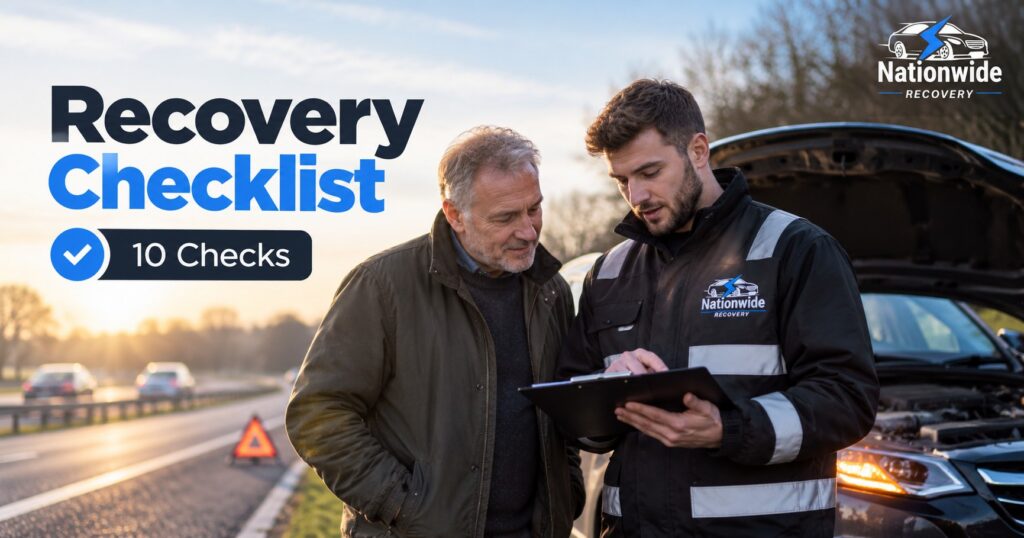
How to choose a car recovery company comes down to ten checks: coverage, response time, pricing, equipment, insurance, vehicle capability, destination options, communication, reviews, and booking clarity. A suitable provider should explain what it can do, what the quote includes, and how quickly assistance can reach you.
This matters because recovery quality involves more than finding the first available truck. Which? surveyed more than 8,500 breakdown-service users for its 2026 provider research, assessing factors including waiting time and call-out outcomes.
This guide is for UK drivers comparing recovery companies before booking. It gives you a practical checklist that takes only a few minutes to use.
How to Choose a Recovery Company
The easiest way to choose a recovery provider is to compare the complete service rather than one feature. Price matters, but so do location, vehicle capability, equipment, response, and clear communication.
Use the ten checks below before confirming dispatch.
1. Check the Coverage Area
First, confirm that the recovery company currently serves your exact location and required destination. A provider with suitable coverage can assess your journey more accurately.
Give the operator:
- your postcode;
- road name;
- motorway and direction;
- nearest junction;
- live map location;
- destination postcode.
Nationwide Recovery provides 24/7 breakdown recovery across Greater Manchester, the North West, and wider UK locations.
Location also affects response planning.
A recovery vehicle already serving your area may have a different arrival estimate from one travelling much further.
2. Ask About Response Time
Ask for the current estimated response for your actual location. A useful estimate should reflect traffic, vehicle availability, and the equipment your job needs.
Avoid comparing companies using generic advertising claims alone.
Instead ask:
“What is the estimated arrival time for my location right now?”
That gives you information connected to your booking.
Response can vary according to:
- traffic;
- road conditions;
- collection location;
- time of booking;
- recovery vehicle availability;
- specialist equipment requirements.
Nationwide Recovery’s website states that response depends on location, with the team aiming to arrive as quickly as possible.
3. Confirm the Complete Quote
Ask what the complete recovery quote includes before dispatch. This makes it easier to compare providers on the same basis.
A recovery quote can reflect:
- attendance;
- loading;
- mileage;
- vehicle type;
- journey distance;
- specialist requirements;
- destination.
Ask:
“Is this the complete amount for collecting my vehicle and taking it to my chosen destination?”
If you want a deeper explanation of pricing factors, read our UK car recovery cost guide.
That article owns the detailed pricing topic.
This checklist only uses price as one provider-selection factor.
4. Check Recovery Equipment
A recovery company should have access to equipment suitable for your vehicle’s condition, size, and position. The correct method depends on the actual job.
DVSA guidance defines recovery vehicles around lifting, towing, and transporting disabled vehicles. It also covers vehicle weights, equipment, maintenance, and operational requirements.
Tell the provider if your vehicle has:
- locked wheels;
- steering restrictions;
- low suspension;
- accident damage;
- limited access;
- unusual dimensions;
- four-wheel drive;
- electric propulsion.
The operator can then assess the recovery requirements before travelling.
5. Confirm Vehicle Protection
Ask how your vehicle is protected while being loaded and transported. The provider should be able to explain its handling process clearly.
You can also ask what insurance arrangements apply while your vehicle is in its care.
The important question is simple:
“How is my vehicle covered while you transport it?”
A clear answer gives you useful information before booking.
It also allows you to understand how the provider handles responsibility during collection and transport.
6. Explain Vehicle Condition
A suitable recovery company should ask about the vehicle before dispatch. Vehicle condition can determine which equipment and loading method is appropriate.
Tell the operator:
- registration;
- make and model;
- whether it starts;
- whether it rolls;
- whether it steers;
- whether neutral engages;
- whether the wheels are damaged;
- whether there is accident damage.
Do not worry about diagnosing the exact mechanical fault.
Describe what happened and what the vehicle currently does.
That information is more useful for recovery planning.
7. Confirm Your Destination
Check that the provider can transport the vehicle to your required destination. Do this before dispatch rather than choosing the destination later.
Common destinations include:
- home;
- local garage;
- dealership;
- bodyshop;
- specialist workshop;
- storage location.
For a planned movement where recovery is not required, our vehicle towing service may be the more relevant option.
Give both postcodes whenever possible.
That helps the company understand the complete journey.
8. Review Customer Feedback
Recent reviews can help you understand how previous customers experienced the company’s communication, arrival process, and vehicle handling. Look for patterns rather than relying on one comment.
Which? uses real customer experience as an important part of its breakdown-provider research.
Its 2026 methodology considered customer satisfaction, waiting time, and call-out outcomes.
For a local recovery company, review comments about:
- response;
- communication;
- driver professionalism;
- quote clarity;
- vehicle care;
- booking experience.
Recent reviews can be especially useful because operations can change over time.
9. Assess Communication
Good recovery communication should make the next steps easy to understand. The operator should ask useful questions and explain what happens after booking.
Pay attention to whether the company asks for:
- your exact location;
- registration;
- vehicle type;
- vehicle condition;
- access information;
- destination.
Those questions are practical.
They help match the response to the job.
If the issue might be resolved without transportation, roadside assistance may also be relevant.
10. Check the Booking Process
Before confirming, make sure you know what has been agreed. You should understand the vehicle, pickup, destination, quote, and expected response.
Use this final booking check:
LOCATION → VEHICLE → CONDITION → DESTINATION → RESPONSE → QUOTE
Confirm each item once.
This takes less than a minute.
It also creates a clear understanding between you and the recovery provider.
Recovery Company Comparison
Use this table when comparing two or three providers.
| Check | What to Ask | What You Need |
| Coverage | Do you cover my location? | Clear confirmation |
| Response | When can you reach me? | Current estimate |
| Price | What is the complete quote? | Clear total |
| Equipment | Can you handle this vehicle? | Suitable method |
| Vehicle care | How is it protected? | Clear process |
| Capability | Can you handle its condition? | Confirmed ability |
| Destination | Can you take it there? | Destination confirmed |
| Reviews | What do recent customers say? | Consistent feedback |
| Communication | What details do you need? | Clear questions |
| Booking | What happens next? | Simple process |
Do not judge one factor alone.
Look at the complete service.
Cheapest or Best Value?
The lowest quote does not automatically tell you which recovery service best fits the job. Compare what each quote includes and whether the provider can complete your specific recovery.
For example, one quote may include the complete journey.
Another may use a different mileage structure.
Equipment requirements can also differ.
Your goal should be a clear quote for the correct service.
Local or Nationwide Recovery?
A local recovery company can be useful for nearby assistance, while broader coverage can help with longer journeys. The best fit depends on where your vehicle is and where it needs to go.
Nationwide Recovery is based in Oldham.
Coverage includes Greater Manchester, surrounding North West areas, and wider UK journeys.
For local recovery, accurate location details help identify the most suitable response.
For longer transport, both collection and destination postcodes become especially important.
What Information Should You Give?
Giving complete information helps a recovery company assess the job before dispatch. It can support clearer response planning and quote preparation.
Have these details ready:
- Current location.
- Vehicle registration.
- Make and model.
- Vehicle condition.
- Whether wheels roll.
- Whether steering operates.
- Access restrictions.
- Required destination.
This information also helps you compare providers fairly.
Each company is then quoting the same job.
Questions Before You Book
Ask these ten questions:
- Do you cover my current location?
- What is the current response estimate?
- What does the complete quote include?
- Can your equipment handle my vehicle?
- How is my vehicle protected during transport?
- Can you handle its current condition?
- Can you take it to my chosen destination?
- Is the quoted journey fully confirmed?
- What information do you need from me?
- What happens after I book?
Save this checklist on your phone.
It can make provider selection much easier when you need assistance.
Why Operator Standards Matter
Vehicle recovery involves moving another vehicle on public roads, so equipment and roadworthiness matter. DVSA publishes specific safety guidance for recovery operators.
Its guidance covers areas including:
- vehicle maintenance;
- weight;
- recovery equipment;
- driver requirements;
- vehicle safety checks.
DVSA states that routine maintenance and vehicle safety checks remain important for recovery operations.
Customers do not need to understand every technical regulation.
However, it is reasonable to ask how the provider manages its recovery equipment and vehicle transport process.
Choosing Nationwide Recovery
Nationwide Recovery provides 24/7 vehicle assistance from its base in Oldham.
Services include:
- breakdown recovery;
- vehicle towing;
- roadside assistance;
- accident recovery;
- planned vehicle movement.
The right service depends on your situation.
If your car has stopped unexpectedly, recovery may be appropriate.
If your main requirement is moving a vehicle between locations, vehicle towing may fit better.
Call Nationwide Recovery: 0161 706 0346
Have your location, vehicle details, condition, and destination ready.
Final Summary
How to choose a car recovery company is easier when you compare ten practical factors rather than one headline claim.
Check:
coverage → response → price → equipment → vehicle care → capability → destination → reviews → communication → booking
The provider should understand your actual vehicle before dispatch.
It should also explain the journey and quote clearly.
Nationwide Recovery provides 24/7 vehicle recovery, roadside assistance, and towing from Oldham across Greater Manchester and wider UK locations.
Call 0161 706 0346 for a job-specific recovery quote.
Frequently Asked Questions
Question: How do I choose a car recovery company?
Answer: Check the company’s coverage, current response estimate, complete quote, equipment, vehicle-handling process, capability, destination options, reviews, communication, and booking process. Give every provider the same vehicle and journey information so you can compare like-for-like recovery services.
Question: What should I ask before booking recovery?
Answer: Ask whether the company covers your location, when it can arrive, what the complete quote includes, and whether it can handle your vehicle. Also confirm the destination, equipment requirements, and what information the driver needs before dispatch.
Question: Should I choose the cheapest recovery company?
Answer: Compare the complete service rather than the headline price alone. Check what the quote includes, the response estimate, vehicle capability, equipment, and destination. Two prices can represent different recovery arrangements, so like-for-like comparison gives you better information.
Question: How can I check a recovery company?
Answer: Review its website, recent customer feedback, services, coverage, contact details, and booking process. Ask direct questions about the recovery method and how your vehicle will be handled. Clear answers help you understand the service before confirming dispatch.
Question: Does equipment matter for car recovery?
Answer: Yes. Vehicle size, wheel movement, steering, ground clearance, accident damage, and access can influence the equipment required. Give the provider accurate information so it can assess a suitable recovery method before sending a vehicle.
Question: Should recovery companies give a quote first?
Answer: Ask for the complete job-specific quote before confirming dispatch whenever possible. Provide your collection location, vehicle condition, and destination first. This helps the provider calculate the recovery requirement and makes comparison between companies much clearer.
Question: What details should I give recovery?
Answer: Provide your exact location, registration, vehicle make and model, current condition, access information, and destination. Also mention whether the vehicle rolls, steers, and selects neutral. These details help the provider assess the recovery before dispatch.