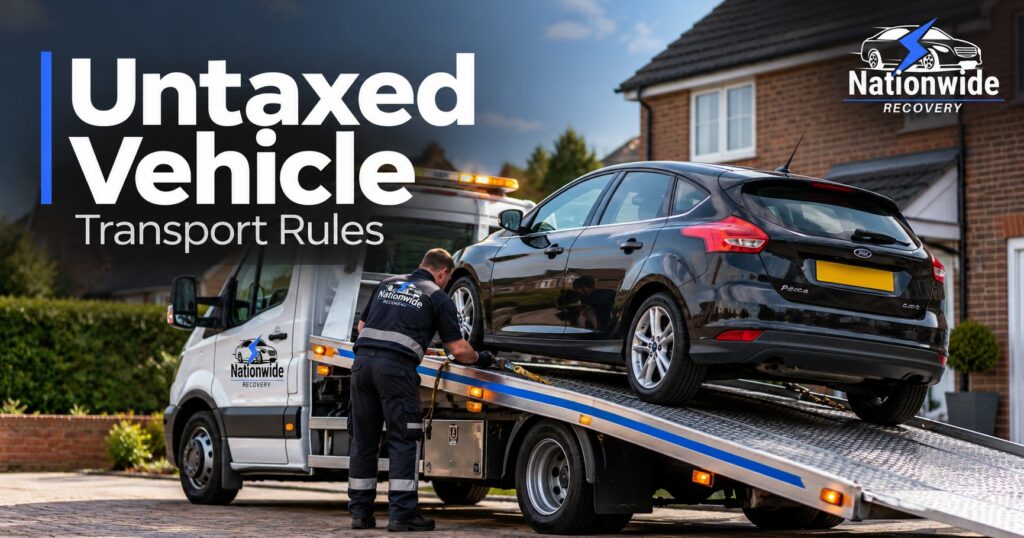
You can transport a car without tax in the UK when the vehicle is moved without being driven or kept on a public road, such as on a suitable recovery transporter or trailer. A SORN or newly purchased untaxed vehicle can therefore be professionally transported between suitable locations.
GOV.UK states that vehicles used or kept on public roads normally need vehicle tax. It also specifically says an untaxed vehicle returning to the UK cannot be driven back and instead must be transported.
This guide explains how to transport car without tax legally, including SORN vehicles, recent purchases, MOT situations, non-runners, and damaged cars.
Can You Transport an Untaxed Car?
Yes. An untaxed vehicle can be transported rather than driven on the public road. Professional vehicle transport is particularly useful when the vehicle needs moving between private locations, a seller, garage, workshop, storage site, or another agreed destination.
The important distinction is between driving the car and carrying the car.
Vehicle tax rules apply to using or keeping the vehicle on public roads.
When a suitable recovery truck carries the vehicle, the untaxed car itself is not being driven between the locations.
GOV.UK provides a clear example for untaxed vehicles returning to Britain.
Its guidance says an untaxed vehicle returning to the UK cannot be driven back and must instead be transported.
Can You Drive Without Tax?
You normally need to tax a vehicle before driving or keeping it on a public road. GOV.UK provides limited exceptions, so normal vehicle transport should not be confused with driving an untaxed car.
The Highway Code states that Vehicle Excise Duty must be paid for motor vehicles used or kept on public roads.
If the vehicle is staying off-road, it may instead need a Statutory Off Road Notification.
This distinction matters when arranging collection.
A vehicle can be:
- taxed and road-ready;
- untaxed and awaiting transport;
- declared SORN;
- newly purchased;
- awaiting MOT;
- non-running;
- undergoing repair.
Tell the transport provider which situation applies.
What Does SORN Mean?
SORN means Statutory Off Road Notification. It tells the Driver and Vehicle Licensing Agency that a vehicle is being kept off public roads.
GOV.UK says a vehicle is considered off-road when it is not kept or used on a public road.
Examples include:
- a garage;
- private driveway;
- suitable private land.
A SORN vehicle normally cannot be driven or kept on a public road.
A SORN remains active until the vehicle is taxed, sold, permanently exported, or scrapped.
You do not need to renew it annually.
Can You Transport a SORN Car?
Yes, a SORN vehicle can be professionally transported between suitable locations without driving it on the public road. This is useful when the car needs moving while remaining off-road.
For example, you may want to move a SORN car:
- from one private driveway to another;
- to a workshop;
- to secure storage;
- to a restoration specialist;
- from a seller;
- after purchasing a project vehicle.
A suitable transporter keeps the vehicle from being driven on public roads during the journey.
Nationwide Recovery provides vehicle towing and transport services for cars requiring planned movement.
Give the team the vehicle’s tax status and condition before booking.
Buying an Untaxed Car
Vehicle tax does not transfer to the new keeper when a car is sold. If you buy a car and want to drive it away, you normally need to tax it first.
GOV.UK specifically states:
- the previous keeper’s tax is cancelled;
- tax does not transfer to the buyer;
- the new keeper must tax the vehicle before driving it;
- alternatively, the new keeper can declare it off-road.
This rule is especially relevant when buying used vehicles privately.
A seller may tell you the car was taxed before the sale.
That tax does not become yours.
Transport Instead of Driving
If you do not plan to tax the vehicle immediately, transportation can solve the movement problem.
For example:
Seller’s driveway → transporter → buyer’s driveway
The purchased vehicle does not need to be driven between those locations.
Once it reaches the destination, make sure its tax or SORN status matches how it will be kept and used.
Does SORN Transfer to a Buyer?
No. SORN does not transfer when a vehicle changes keeper. A new keeper who wants to keep the vehicle off-road needs to make a new SORN.
DVLA specifically addresses this point in its SORN guidance.
This means a buyer has two main choices.
Option 1: Use the Vehicle
Tax the vehicle and meet the other legal requirements before normal road use.
Option 2: Keep It Off-Road
Make a SORN and keep the vehicle away from public roads.
If it needs moving between private locations, arrange suitable vehicle transport.
What About an Expired MOT?
An expired MOT and an untaxed vehicle are related issues, but they are not the same legal requirement. A vehicle can have different tax, MOT, insurance, and SORN statuses.
GOV.UK says a vehicle with an expired MOT normally cannot be driven or parked on the road.
However, there are specific MOT-related exceptions.
A vehicle may be driven:
- to a pre-arranged MOT;
- from an MOT location for qualifying repairs.
The vehicle must still meet applicable roadworthiness requirements.
SORN and MOT Appointments
DVLA also confirms that a SORN vehicle can be driven to a pre-arranged MOT appointment.
This is a narrow exception.
It should not be treated as permission for ordinary trips.
If you prefer not to drive the vehicle, a transporter can move it instead.
Transporter or Tow?
For an untaxed or SORN vehicle, carrying the complete vehicle on suitable transport equipment gives the clearest separation from normal road use. It is also useful for vehicles that cannot safely move under their own power.
People often use “towing” as a general word.
However, towing methods differ.
| Method | Vehicle Position | Typical Use |
| Recovery transporter | Vehicle carried on truck | Planned transport or recovery |
| Trailer | Vehicle carried on trailer | Planned vehicle movement |
| Recovery towing | Method depends on equipment | Breakdown or recovery |
| Driving | Vehicle operates on road | Requires applicable road compliance |
For an untaxed vehicle, explain the tax and SORN status before booking.
The recovery company can then plan the appropriate transport method.
Why Professional Transport Helps
Professional transport allows a vehicle to move without relying on its ability to drive normally. This makes it useful for several planned situations.
Examples include:
- untaxed purchases;
- SORN cars;
- restoration projects;
- vehicles awaiting work;
- non-running cars;
- accident-damaged vehicles;
- auction purchases;
- long-stored vehicles.
Nationwide Recovery’s vehicle towing service can move vehicles to an agreed destination.
For an unexpected roadside issue instead, breakdown recovery may be more suitable.
Moving a Non-Runner
A non-running vehicle can still be transported if suitable loading equipment is available. The engine does not necessarily need to start for the vehicle to be moved on a transporter.
Tell the operator whether:
- the wheels roll;
- the steering moves;
- neutral engages;
- keys are available;
- the handbrake releases;
- the tyres are inflated.
This information helps assess loading.
If a wheel is locked or steering does not operate, say so before collection.
Different conditions may require different equipment.
Moving a Damaged Vehicle
An accident-damaged car can often be transported without being driven. Its condition determines how the recovery provider plans collection and loading.
Tell the operator about:
- damaged wheels;
- suspension condition;
- steering;
- fluid leaks;
- body damage;
- low ground clearance;
- missing components.
For post-collision situations, Nationwide Recovery also provides accident recovery support.
Photographs can help when safe and practical.
A wide image can show the vehicle position and access.
Does the Car Need Insurance?
The insurance position depends on whether the vehicle is being used on the road or kept under SORN. GOV.UK says SORN is used when a vehicle is taken off-road and the keeper wants to stop taxing and insuring it.
This is different from the transporter operator’s own insurance arrangements.
Before booking professional vehicle transport, you can ask:
“What cover applies while my vehicle is in your care and being transported?”
That provides clarity for the journey.
If you intend to drive the vehicle, separate road-use insurance requirements apply.
Where Can an Untaxed Car Be Kept?
An untaxed SORN vehicle should normally be kept away from public roads. GOV.UK gives garages, driveways, and private land as common examples of off-road locations.
Do not assume every publicly accessible car park counts as suitable private storage.
The important test is not simply who owns the land.
Public-road and accessible-area rules can be more specific.
If you need to move the car from one compliant off-road location to another, vehicle transport can provide the connection.
Untaxed Car After Purchase
Consider this practical example.
You buy a project car in Manchester.
The seller has completed the change of keeper.
You want to store the vehicle on your private driveway in Oldham.
Because the seller’s tax does not transfer to you, driving it home without arranging your own tax would not be the normal compliant route.
Instead, you can:
- Arrange professional vehicle transport.
- Give the seller’s collection address.
- Provide your home destination.
- Confirm vehicle condition.
- Load the car onto suitable transport.
- Deliver it to the private driveway.
- Complete the appropriate SORN or tax arrangements.
This is a common planned-transport scenario.
It also avoids relying on the car being ready for immediate road use.
Transporting to an MOT
A pre-arranged MOT is a specific exception that can allow certain otherwise off-road vehicles to be driven to testing. However, transporting the car remains an alternative.
Transport may suit you when:
- the vehicle has been stored for a long period;
- roadworthiness is uncertain;
- the battery is flat;
- tyres need attention;
- the car is a restoration project;
- you prefer not to drive it.
GOV.UK confirms the pre-arranged MOT exception, but also makes clear that roadworthiness rules still apply.
Transporting the car removes the need to rely on that driving exception.
How Much Does Transport Cost?
Vehicle transport pricing depends on the actual movement rather than the vehicle’s tax status alone. Distance, collection access, vehicle size, condition, and loading requirements can influence the quote.
An untaxed car that rolls normally may have a straightforward loading requirement.
A project car with locked wheels may need additional planning.
For wider recovery pricing information, see our UK car recovery cost guide.
When requesting a quote, provide both postcodes.
Also describe the vehicle’s mobility accurately.
What Information Is Needed?
A transport provider needs enough information to identify the vehicle, plan loading, and calculate the journey. Have the key details ready before booking.
Use this checklist:
COLLECTION → VEHICLE → CONDITION → ACCESS → DESTINATION
Provide:
- Collection postcode.
- Destination postcode.
- Vehicle registration.
- Make and model.
- Tax or SORN status.
- Whether the engine starts.
- Whether the wheels roll.
- Whether steering works.
- Whether keys are available.
- Any access restrictions.
Good information makes the booking process more straightforward.
It also helps the provider arrange suitable equipment.
Can Nationwide Recovery Move It?
Nationwide Recovery provides planned vehicle transport alongside breakdown and towing services.
Vehicles may need moving for many reasons.
These can include:
- recent purchases;
- SORN storage;
- garage visits;
- restoration;
- mechanical work;
- non-running condition;
- accident repair;
- relocation.
Nationwide Recovery is based in Oldham.
The team serves Greater Manchester, the North West, and wider UK locations.
For a quote, provide your collection postcode, destination postcode, vehicle make, model, and condition.
Call Nationwide Recovery: 0161 706 0346
Final Summary
You can transport car without tax when the vehicle is moved without being used as the road vehicle itself.
For most planned movements, that means using suitable professional vehicle transport.
This is particularly useful for:
- SORN vehicles;
- newly purchased cars;
- non-runners;
- project cars;
- damaged vehicles;
- cars awaiting MOT or repair.
Remember three key rules.
Tax does not transfer to a buyer.
SORN does not transfer to a buyer.
A SORN vehicle normally needs to stay off public roads, apart from specific legal exceptions.
For planned movement, a recovery transporter provides a straightforward way to move the vehicle between agreed locations.
Nationwide Recovery provides vehicle towing and transport across Greater Manchester, the North West, and wider UK areas.
Call 0161 706 0346 for a vehicle transport quote.
Frequently Asked Questions
Question: Can you transport a car without tax?
Answer: Yes. An untaxed car can be professionally transported without being driven on the public road. A suitable recovery transporter or trailer can carry the vehicle between agreed locations. You should still ensure the vehicle’s tax or SORN status is correct for where it is kept.
Question: Can I drive an untaxed car home?
Answer: Normally, a vehicle must be taxed before you drive it on public roads. Vehicle tax does not transfer when you buy a car. If you do not want to tax it immediately, professional vehicle transport can move it to a suitable off-road destination.
Question: Can I transport a SORN car?
Answer: Yes. A SORN vehicle can be transported between suitable locations without being driven on the public road. Professional vehicle transport is useful for moving it to a driveway, garage, workshop, storage site, or another appropriate private location.
Question: Can I drive a SORN car to an MOT?
Answer: Yes, GOV.UK allows a SORN vehicle to be driven to or from a pre-arranged MOT or qualifying testing appointment. The vehicle must still meet applicable roadworthiness requirements. You can also choose professional transport instead of driving it.
Question: Does car tax transfer when buying?
Answer: No. Vehicle tax does not transfer to the new keeper when a car changes ownership. The buyer must arrange new vehicle tax before normal road use or make a new SORN if the vehicle will remain off-road.
Question: Does SORN transfer to a new owner?
Answer: No. A SORN from the previous keeper does not transfer to the buyer. If the new keeper wants to keep the vehicle off-road, they need to make their own SORN after taking ownership.
Question: Can an untaxed non-runner be transported?
Answer: Yes. A non-running untaxed car can be transported using suitable recovery equipment. Tell the provider whether the wheels roll, steering moves, neutral engages, and keys are available so the operator can plan the loading process.
Question: Does an untaxed car need an MOT for transport?
Answer: A vehicle being carried on suitable transport is different from driving that vehicle on the road. MOT requirements become particularly relevant when you intend to drive it. If the MOT has expired, professional transport can move the vehicle without relying on the MOT driving exception.