

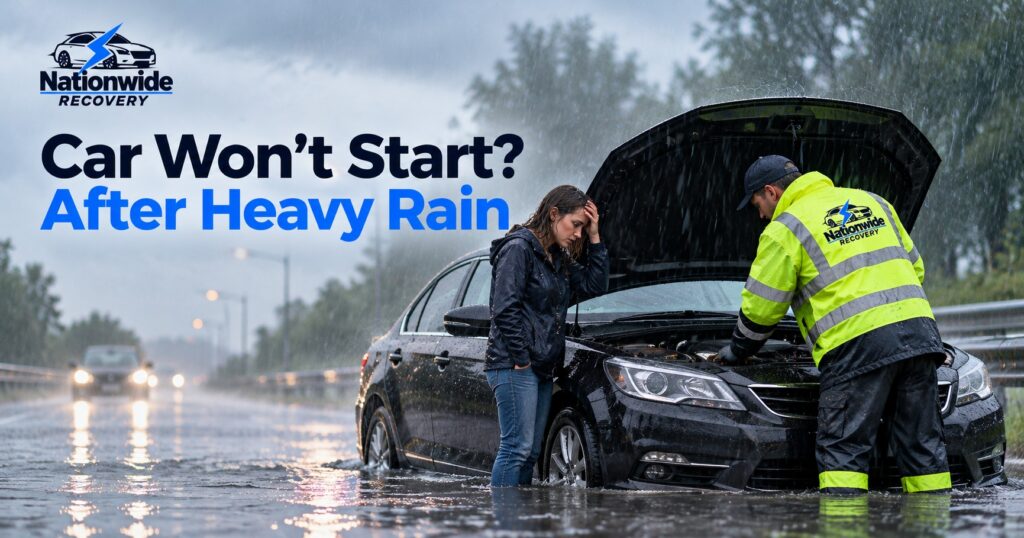
If your car won’t start after rain, moisture may be exposing a weakness in the battery, ignition system, wiring, starter circuit, or electrical connections. The sound your car makes when you try to start it is often the quickest way to narrow down the problem.
Heavy rain also creates extra roadside risks. The Highway Code, updated in 2025, states that stopping distances are at least twice as long on wet roads. The Met Office also warns that around 30 cm of moving water can float a car.
This guide explains the likely causes, safe checks you can make, and when to arrange professional help in Oldham or Greater Manchester.
Why Rain Can Stop a Car Starting
A car not starting after heavy rain does not usually mean rain has suddenly damaged a healthy engine. More often, moisture exposes an existing weak point.
Water or high humidity can affect:
- ignition coils;
- spark plug connections;
- older distributor systems;
- battery terminals;
- earth connections;
- electrical connectors;
- starter connections;
- fuse boxes;
- sensors and relays.
Modern vehicles are designed to operate in wet conditions. Therefore, repeated wet-weather starting problems deserve investigation.
Automotive component manufacturer HELLA specifically identifies humidity entering ignition-system wiring as a possible cause of increased electrical resistance and ignition faults.
If your car won’t start when wet but works normally after drying, that pattern is an important diagnostic clue.
Listen Before Checking Anything
Before opening the bonnet, listen to what happens when you attempt one normal start.
The symptom helps separate several very different problems.
The engine does not crank
You turn the key or press the start button, but the engine does not turn.
Possible causes include:
- weak or discharged battery;
- loose battery terminal;
- corroded electrical connection;
- starter motor fault;
- starter relay problem;
- poor earth connection;
- immobiliser or electrical issue.
You hear rapid clicking
Repeated clicking commonly suggests the starter is not receiving enough usable electrical power.
The battery may be weak.
However, poor terminals or electrical resistance can produce similar symptoms.
The engine cranks slowly
Slow cranking can point towards:
- weak battery;
- high resistance at a connection;
- damaged battery terminal;
- starter problem;
- charging-system issue.
A professional battery test is more reliable than replacing the battery based on symptoms alone.
The engine cranks normally but will not start
This changes the likely diagnosis.
If the starter turns the engine normally, the problem may involve:
- ignition;
- fuel delivery;
- engine sensors;
- wet electrical connections;
- immobiliser systems;
- engine management electronics.
Wet-weather ignition problems become more likely if the same vehicle starts normally once conditions become dry.
Wet Ignition Components
Moisture around ignition components is one of the strongest explanations when a car won’t start after rain but operates normally during dry weather.
Petrol engines need a correctly timed spark.
If moisture interferes with that spark, the engine may:
- crank without starting;
- misfire;
- start and immediately stall;
- run roughly;
- hesitate under acceleration.
Ignition coils
Modern petrol vehicles commonly use coil-on-plug ignition systems.
Ignition coils operate at high voltage. Damaged insulation, cracked housings, ageing seals, or contaminated connections can make moisture more problematic.
NGK notes that ignition-coil materials must resist both heat and moisture within the engine bay.
A coil beginning to fail may therefore perform normally in dry weather but become unreliable when damp.
Spark plug boots and leads
Worn insulation can allow electrical energy to escape before reaching the spark plug correctly.
Possible clues include:
- rough running after rain;
- intermittent misfires;
- difficult starting;
- engine warning light;
- problems that disappear once everything dries.
Do not touch ignition components while the engine is running.
Ignition systems can generate dangerous voltages.
Distributor cap
Older petrol vehicles may still use a distributor.
Moisture or condensation inside the distributor cap can disrupt spark distribution.
This cause is less relevant to most modern vehicles, but remains important on older cars.
Battery and Connection Problems
A car battery in wet weather is often blamed immediately, but rain does not normally flatten a healthy battery simply because it gets wet outside.
The problem may instead be a battery already near failure.
Wet conditions can also expose poor electrical connections.
Look for symptoms such as:
- dashboard lights becoming very dim;
- slow engine cranking;
- repeated clicking;
- electrical systems resetting;
- car starting after a jump start.
Corrosion around battery terminals can increase electrical resistance.
Do not disconnect, clean, or jump-start a battery unless you know the correct procedure for your vehicle.
Modern vehicles can have manufacturer-specific requirements.
If the symptoms point towards a discharged battery, Nationwide Recovery provides jump-start and battery assistance.
A jump start should be treated as a diagnostic clue rather than proof that the battery itself has failed.
Water in Electrical Connections
Car electrical problems after rain can occur when water reaches wiring, connectors, grounding points, or control circuits.
Moisture can cause:
- increased electrical resistance;
- intermittent signals;
- short circuits;
- blown fuses;
- communication faults;
- corrosion;
- unexpected warning lights.
HELLA notes that persistent moisture around electrical contacts can cause corrosion and increased resistance.
That can create voltage loss and intermittent electrical failures.
The frustrating part is that the vehicle may work normally again after drying.
That does not mean the problem has disappeared.
A damaged seal or corroded connector can allow the same fault to return during the next downpour.
Starter Motor Problems
Rain-related starting problems do not always come from the ignition system.
Moisture can also affect starter connections.
A starter-related problem is more likely when:
- the engine does not turn;
- there is one solid click;
- starting is intermittent;
- the starter turns unusually slowly.
According to HELLA, moisture and corrosion at starter electrical terminals can increase resistance and cause voltage drops.
That can eventually prevent starting.
Do not assume the starter motor needs replacement because you hear a click.
Battery condition, cables, earth connections, relays, and control circuits should also be checked.
Water in the Air Intake
This is the most serious rain-related situation in this guide.
If the vehicle has recently travelled through deep standing water or flood water, do not repeatedly attempt to restart it.
Water entering the air intake can reach the engine.
Because liquid does not compress like air, significant water ingestion can cause severe internal engine damage.
The Met Office advises drivers not to enter flood water.
Its guidance states that about 30 cm of moving water may be enough to float a car.
If the engine stopped while crossing deep water:
- Do not repeatedly crank the engine.
- Switch the ignition off.
- Move to a safe place if possible.
- Keep away from moving traffic.
- Arrange professional assessment or recovery.
If the vehicle cannot move safely, use a professional vehicle towing service rather than risking further damage.
Sensors, Relays and Fuse Boxes
Modern vehicles depend heavily on electronic sensors and control units.
Water entering the wrong connector can stop the engine from starting even when the battery and starter work normally.
Possible affected components include:
- crankshaft position sensor;
- camshaft position sensor;
- engine control unit connectors;
- starter relay;
- fuel pump relay;
- fuse box;
- body control module;
- wiring harness connections.
A car may crank perfectly but fail to start because the engine management system is missing a critical signal.
This is why replacing parts without diagnostic testing can become expensive.
Intermittent faults after rain are especially useful information for a technician.
Tell them exactly when the failure occurs.
What to Do Immediately
If your car won’t start after rain, follow a simple safety-first process.
1. Check your surroundings
Make sure the vehicle is in a safe position.
If you are close to moving traffic, diagnosis is secondary to personal safety.
2. Try one normal start
Listen carefully.
Identify whether you hear:
- nothing;
- one click;
- repeated clicks;
- slow cranking;
- normal cranking.
Avoid continuously operating the starter.
3. Check the dashboard
Look for:
- battery warning;
- immobiliser warning;
- engine warning light;
- unusual electrical messages;
- flickering displays.
Take a photo if a warning disappears later.
4. Look for obvious water exposure
Only inspect the vehicle when it is safely parked.
Check whether:
- the vehicle crossed standing water;
- water entered the cabin;
- the engine bay experienced unusual flooding;
- electrical problems began directly after the rain.
Do not start dismantling electrical components beside a busy road.
5. Avoid repeated starting after flooding
If the engine stopped after driving through substantial water, repeated cranking could make a serious problem worse.
Arrange professional assistance.
6. Request help if the cause is unclear
Nationwide Recovery provides 24/7 roadside assistance for drivers in Oldham, Greater Manchester, and surrounding areas.
If a safe roadside solution is not practical, recovery may be the better option.
Wet-Weather Starting Problem Table
| What Happens | Possible Cause | Rain Connection | Sensible Next Step |
| Rapid clicking | Weak battery or poor connection | Damp corrosion may increase resistance | Battery and connection check |
| Slow cranking | Battery, terminals or starter | Existing weakness becomes more noticeable | Test battery and starting circuit |
| Normal crank, no start | Ignition, sensor or fuel issue | Moisture may affect coils or connectors | Diagnostic assessment |
| Starts but misfires | Coil, lead or spark issue | Dampness may disrupt ignition | Avoid hard driving and investigate |
| Multiple warning lights | Electrical connection or water ingress | Wet connector or control circuit possible | Electrical diagnostics |
| No response at all | Battery, starter, relay or electrical supply | Moisture may affect connections | Roadside diagnosis |
| Engine stopped in flood water | Possible water ingestion | Direct water exposure | Do not keep restarting; arrange recovery |
This symptom-based approach helps avoid replacing the wrong part.
Several faults can create similar starting problems.
When to Call Roadside Assistance
Roadside assistance makes sense when you cannot confidently identify or safely resolve the problem.
Call for help if:
- the car remains completely unable to start;
- you are stranded away from home;
- the vehicle is beside a busy road;
- electrical warnings appear;
- the car repeatedly starts and stalls;
- you smell burning;
- wiring appears damaged;
- water entered the vehicle;
- the battery repeatedly becomes flat;
- the engine stopped after driving through water.
For drivers searching for roadside assistance Oldham, Nationwide Recovery operates from Oldham and provides 24/7 vehicle assistance across Greater Manchester and surrounding locations.
Coverage includes areas such as Oldham, Rochdale, Manchester, Stockport, Tameside, Bolton, Trafford, Wigan, Mossley, Stalybridge, and nearby communities.
If you are stranded near routes such as the A62, A627(M), M60, or surrounding Greater Manchester roads, send your exact location when requesting help.
That makes it easier to identify your position.
Roadside help or recovery?
Roadside assistance aims to solve a suitable problem where the vehicle has stopped.
Recovery moves the vehicle when it cannot safely continue.
If a battery boost safely restores normal operation, roadside assistance may be enough.
If an electrical, ignition, flood, or mechanical problem remains unresolved, breakdown recovery may be safer.
How to Prevent Another Wet-Weather Breakdown
A vehicle should not repeatedly become unreliable simply because it rains.
If wet weather consistently triggers the problem, find the underlying cause.
Check the battery
Have the battery tested if starting has become slower.
Do not wait for complete failure.
Inspect electrical connections
Ask for damaged, loose, or corroded connections to be checked.
That includes important earth points.
Inspect ignition components
On petrol vehicles, ageing coils, plugs, boots, and leads deserve attention.
Cracks or damaged seals can allow moisture to become a problem.
Check drainage and seals
Blocked drainage channels or damaged seals can direct water toward areas that should remain dry.
Check for unexplained dampness inside the cabin.
Investigate repeated warning lights
Do not ignore electrical warnings simply because they disappear after dry weather returns.
Intermittent moisture-related faults often become more frequent over time.
Avoid flood water
The safest strategy is not to drive through flooded roads.
The Met Office severe-weather driving guidance recommends turning around and finding another route when a road is flooded.
Final Answer
If your car won’t start after rain, first identify whether the engine is cranking normally.
Normal cranking with no start can point towards damp ignition components, sensors, relays, or electrical connectors. Clicking or slow cranking makes battery, connection, or starter problems more likely.
A fault that disappears when the vehicle dries still deserves investigation.
Rain may only be exposing an electrical or ignition weakness that already exists.
Never keep attempting to restart a vehicle that stopped after travelling through deep flood water.
If you are stranded in Oldham or Greater Manchester, Nationwide Recovery can provide roadside assistance, battery support, towing, or breakdown recovery depending on the vehicle’s condition.
Need assistance now?
📞 Call Nationwide Recovery: 0161 706 0346
🌐 https://nationwide-recovery.co.uk/
📍 Based in Oldham, Greater Manchester
Frequently Asked Questions
Question: Why does my car not start after heavy rain?
Answer: A car not starting after heavy rain can indicate moisture reaching ignition components, electrical connectors, starter connections, sensors, or existing corrosion. The exact cause depends heavily on whether the engine cranks normally.
Question: Why does my car start when dry but not when wet?
Answer: If your car won’t start when wet but starts after drying, moisture may be affecting a weak ignition component or electrical connection. Cracked insulation, damaged seals, ageing coils, and corroded connectors are possible causes.
Question: Can rain cause car electrical problems?
Answer: Yes. Car electrical problems after rain can occur when moisture reaches damaged connectors, wiring, fuse boxes, grounding points, or control modules. The fault may disappear temporarily after the affected area dries.
Question: Can rain make a car battery go flat?
Answer: Rain alone should not normally discharge a healthy battery. However, an ageing battery, poor terminals, charging problems, or increased electrical demand can make starting problems more noticeable during bad weather.
Question: Should I jump-start a car after heavy rain?
Answer: A jump start may help when a weak battery is the cause. Do not attempt one if the battery is damaged, submerged, leaking, or the vehicle manufacturer advises against the procedure.
Question: What if my car cranks but won’t start after rain?
Answer: Normal cranking suggests the starter is turning the engine. Wet ignition components, sensors, relays, fuel-delivery problems, immobiliser faults, or electrical connections should then be considered.
Question: Should I restart a car that stopped in flood water?
Answer: Do not repeatedly restart it. Water may have entered the intake or affected electrical systems. Repeated cranking can make some engine problems worse, so professional inspection or vehicle recovery is safer.
Question: Can I get roadside assistance in Oldham for a wet-weather breakdown?
Answer: Yes. Nationwide Recovery provides 24/7 roadside assistance in Oldham and across Greater Manchester. Depending on the fault, assistance may involve a jump start, roadside assessment, towing, or breakdown recovery.
Sources
- GOV.UK – The Highway Code: Driving in Adverse Weather
- Met Office – Driving in Severe Weather
- HELLA – Checking Ignition Coils and Common Faults
- NGK – Ignition Coil Technology