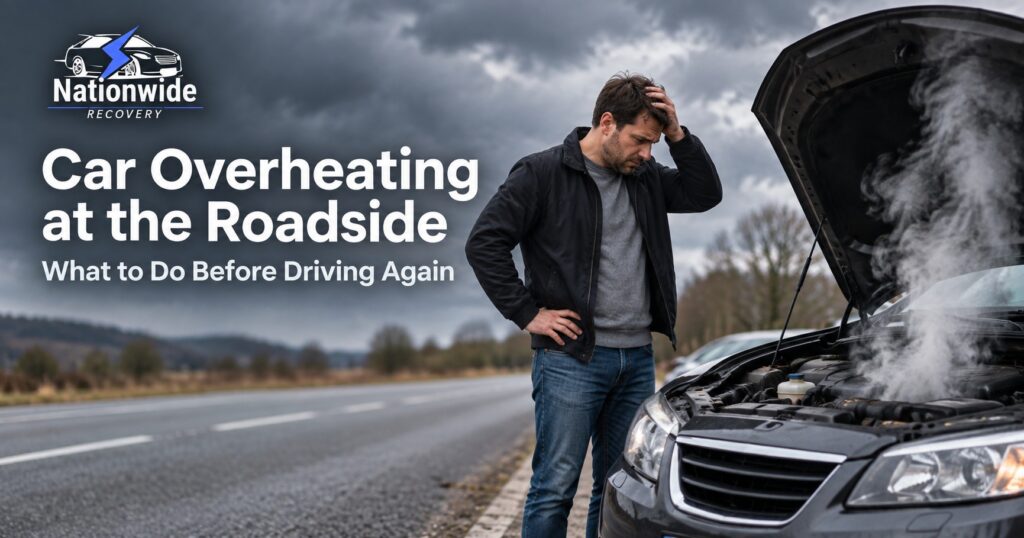
If your car is overheating roadside, stop somewhere safe, switch off the engine and let it cool naturally before touching the cooling system. Never remove a hot coolant cap. Before driving again, check the warning lights, temperature, coolant level and any visible leaks, then arrange professional help if anything remains unusual.
National Highways says its traffic officers deal with more than 85,000 breakdowns each year, and over 40% involve issues including fuel, tyre maintenance, power loss and engine trouble. Simple checks can therefore make a real difference before and during a journey.
This guide is for UK drivers who notice a rising temperature gauge, coolant warning, steam or unusual heat while driving. It explains what to do at the roadside and how to decide whether the car should move again.
What Should You Do First?
If your car is overheating roadside, your first job is to stop safely and remove heat from the situation. Do not keep driving while watching the temperature gauge climb.
Use this sequence:
- Stay calm and check surrounding traffic.
- Reduce speed smoothly.
- Move towards a safe stopping place.
- Use hazard lights when appropriate.
- Apply the parking brake.
- Switch off the engine.
- Keep passengers away from moving traffic.
- Allow the engine to cool naturally.
Do not focus on opening the bonnet immediately.
Safety around traffic comes first.
If the vehicle cannot continue safely, Nationwide Recovery provides 24/7 breakdown recovery.
How Do You Know It Is Overheating?
An overheating engine usually gives one or more warning signs before you continue driving. The most useful clues are the temperature gauge, warning lights, steam, unusual smells and changing engine performance.
Look for:
- temperature gauge moving towards the red;
- coolant or temperature warning light;
- steam from under the bonnet;
- sweet coolant smell;
- reduced engine performance;
- unusual ticking or hot-engine smells;
- coolant visible beneath the vehicle.
National Highways advises drivers to understand dashboard warning lights and seek assistance when warning lights indicate a serious vehicle fault.
Do not use one symptom alone as a diagnosis.
Different cooling-system faults can create similar signs.
How Long Should You Wait?
Wait until the engine has cooled naturally before checking the cooling system. There is no single safe number of minutes for every vehicle because engine size, outside temperature and the cause of overheating all affect cooling time.
The Highway Code gives the clearest rule:
“If your engine overheats you should wait until it has cooled naturally.”
Only after that should the coolant filler cap be removed.
A vehicle may still feel very hot after visible steam disappears.
If you are unsure whether it has cooled enough, wait longer or arrange professional assistance.
Should You Open the Bonnet?
You can consider opening the bonnet only when the vehicle is safely parked and there are no signs of fire. Keep your face and hands away from hot steam or pressurised components.
If you see flames or clear signs of fire, do not open the bonnet.
Move away from the vehicle and call emergency services.
For ordinary overheating, allowing extra airflow around the engine may help cooling once the situation is safe.
However, do not touch:
- coolant caps;
- radiator caps;
- hot hoses;
- metal cooling components;
- visible leaking fluid.
Use your vehicle handbook if you are unsure where components are located.
Can You Check Coolant?
Yes, but only after the engine has fully cooled. Never remove a coolant or radiator cap while the cooling system is hot.
The Highway Code specifically advises waiting for an overheated engine to cool naturally before removing the coolant filler cap.
Once cool, inspect the expansion tank.
Many vehicles have:
- a translucent coolant reservoir;
- MIN and MAX markings;
- manufacturer coolant specifications.
If coolant is below the minimum level, that may help explain the overheating.
However, low coolant can also indicate a leak.
Do not repeatedly top up coolant without understanding why the level has dropped.
What Causes Car Overheating?
Car overheating is usually linked to the engine cooling system being unable to control temperature effectively. Several different components can contribute.
| Possible Cause | Common Clue | Sensible Next Step |
| Low coolant | Low reservoir level | Check when engine is cool |
| Coolant leak | Fluid beneath vehicle | Arrange inspection |
| Thermostat issue | Temperature rises quickly | Diagnostics |
| Cooling fan issue | Overheats in traffic | Professional assessment |
| Water pump issue | Temperature keeps rising | Diagnostics or recovery |
| Radiator issue | Reduced cooling efficiency | Professional inspection |
| Air in cooling system | Irregular temperature | Cooling-system check |
| Low engine oil | Heat and warning signs | Check oil safely |
| Heavy engine load | Temperature rises under load | Stop and assess |
These are possible causes, not a remote diagnosis.
A physical inspection is the best way to confirm the source.
Can You Drive Again?
Only consider driving again when the engine has fully cooled, the temperature has returned to normal, no active warning remains and there is no obvious leak. Even then, monitor the vehicle closely.
Use this restart decision table.
| After Cooling | Recommended Action |
| Temperature normal, no warning, no leak | Consider a short cautious continuation |
| Coolant low | Investigate before driving normally |
| Visible coolant leak | Arrange assistance |
| Temperature rises again | Stop and arrange help |
| Steam returns | Stop and arrange help |
| Warning light remains | Seek diagnostics |
| Engine runs unusually | Arrange inspection |
| Cause remains unclear | Roadside help or recovery |
This is the most important decision point in the guide.
Cooling down does not prove the original cause has disappeared.
What If It Overheats Again?
If the temperature rises again after restarting, stop safely and switch the engine off. Repeated overheating means the cooling system still needs attention.
Do not keep restarting and driving short distances.
Instead, note:
- how quickly the temperature rises;
- whether a warning light appears;
- whether steam returns;
- whether the heater changes temperature;
- whether coolant appears beneath the car.
That information can help a technician.
Nationwide Recovery’s vehicle diagnostics service can help identify faults when warning lights or vehicle behaviour need further assessment.
What If Coolant Is Full?
A full coolant reservoir does not rule out overheating. The problem may involve coolant circulation, cooling fans, the thermostat, water pump, radiator or another system component.
Possible clues include:
Overheating in Traffic
This can point towards reduced airflow or a cooling-fan issue.
Overheating at Speed
This may require broader cooling-system diagnosis.
Temperature Changes Suddenly
A sensor, thermostat or circulation issue may need checking.
No Visible Leak
A system can still have an internal or pressure-related problem.
Do not assume a full coolant tank means the vehicle is ready to continue.
What If It Happens in Traffic?
If your car begins overheating in slow traffic, look for a safe opportunity to leave the flow of traffic and stop. Do not make sudden manoeuvres simply to reach the roadside.
Cooling fans become especially important at low road speed because there is less natural airflow through the radiator.
A vehicle that overheats mainly in:
- queues;
- slow urban driving;
- idling;
- stop-start traffic
may need its cooling fan or cooling system checked.
Once stopped, switch off the engine and let it cool naturally.
What If It Happens on a Motorway?
If the temperature warning appears on a motorway, aim for the safest available stopping place. Leave the motorway at the next safe opportunity if the vehicle can do so safely.
If that is not possible:
- Move left when safe.
- Use an emergency area or hard shoulder if available.
- Stop as far from moving traffic as practical.
- Switch on hazard lights.
- Leave through the traffic-free side if safe.
- Move behind a barrier where possible.
- Arrange professional help.
Do not stop in a live lane unless the vehicle can no longer continue.
If you cannot reach safety or safely leave the vehicle, call 999.
For a complete motorway breakdown process, see Car Broke Down on the Motorway? What to Do Safely in the UK.
Should You Turn the Heater On?
Turning the cabin heater to maximum can sometimes move a small amount of heat away from the engine while you are trying to reach a nearby safe stopping place. It should not be treated as a repair.
Your priority remains getting somewhere safe and stopping.
Use the heater only as a temporary measure while reaching that safe position.
Do not use it as a reason to continue a long journey with a rising temperature gauge.
What If You See Steam?
Steam often suggests hot coolant or water has reached a hot engine component. Stop safely and allow the engine to cool before going near the cooling system.
Do not lean over the bonnet immediately.
Keep hands away from:
- pressurised coolant;
- hoses;
- radiator caps;
- expansion-tank caps.
If the steam is accompanied by a burning smell or signs of fire, move away from the vehicle.
Can You Add Water?
The Highway Code says water or coolant may be added only after an overheated engine has cooled naturally.
Follow the manufacturer’s handbook first.
Different vehicles use different coolant specifications.
If you need to add fluid repeatedly, the cooling system needs inspection.
Topping up is not a substitute for identifying a leak or circulation problem.
What About Electric and Hybrid Cars?
Electric and hybrid vehicles also use thermal-management systems, although their layouts differ from conventional petrol or diesel vehicles.
Do not attempt to work on high-voltage cooling components.
If a warning message appears:
- stop safely;
- consult the vehicle display and handbook;
- do not touch high-voltage components;
- arrange specialist assistance when required.
Tell the recovery operator that the vehicle is electric or hybrid.
That information helps the correct recovery method to be planned.
Recovery or Diagnostics?
Roadside assistance, diagnostics and recovery each solve different problems.
| Situation | Best Next Step |
| Cause appears minor and roadside-safe | Roadside assistance |
| Warning light remains | Vehicle diagnostics |
| Temperature rises repeatedly | Diagnostics or recovery |
| Coolant is leaking | Recovery/inspection |
| Vehicle will not restart | Breakdown recovery |
| Engine behaviour is unusual | Diagnostics |
| Vehicle cannot continue safely | Breakdown recovery |
Nationwide Recovery provides roadside assistance for suitable roadside situations.
If the vehicle cannot continue, professional recovery can move it to an agreed garage, home address or another destination.
What Should You Tell Recovery?
Give the operator clear facts rather than guessing which component has failed.
Provide:
- exact location;
- direction of travel;
- vehicle registration;
- make and model;
- fuel type;
- whether it is hybrid or electric;
- dashboard warnings;
- whether steam appeared;
- whether coolant is visible;
- whether the vehicle restarts.
Also explain whether the vehicle is in a safe position.
Clear information helps the recovery requirement be planned correctly.
How Can You Reduce Overheating?
Regular vehicle checks help identify some cooling-system problems before they interrupt a journey.
National Highways says simple checks can prevent some of the more than 85,000 annual breakdowns its traffic officers deal with.
Before longer journeys, check:
- coolant level when the engine is cold;
- engine oil;
- dashboard warnings;
- visible leaks;
- unusual smells;
- tyre condition;
- fuel or charge level.
National Highways also advises checking engine oil regularly and before long journeys.
Follow the vehicle manufacturer’s service schedule.
Before Driving Again Checklist
Use this short checklist after an overheating incident:
ENGINE COOLED → CHECK → RESTART → MONITOR → DECIDE
- Has the engine cooled naturally?
- Is the coolant level acceptable?
- Is there any visible leak?
- Is the temperature gauge normal?
- Has the warning light gone?
- Does the engine sound normal?
- Is there any steam or unusual smell?
- Does the temperature stay stable after restarting?
- Is the vehicle safe to move?
- Are you confident the problem has settled?
If the answer to the important safety checks is no, arrange professional help.
Final Answer
If your car is overheating roadside, stop safely, switch off the engine and let it cool naturally.
Do not remove a hot coolant cap.
Once cool, check the coolant level, visible leaks, warning lights and temperature gauge.
If the vehicle overheats again, leaks coolant, keeps a warning light on or behaves unusually, avoid continuing the journey.
Nationwide Recovery provides 24/7 roadside support, diagnostics and breakdown recovery for drivers who need professional assistance.
Call Nationwide Recovery: 0161 706 0346
Frequently Asked Questions
Question: What should I do if my car overheats at the roadside?
Answer: Stop in a safe place, switch off the engine and allow it to cool naturally. Do not remove the coolant cap while hot. Once cool, check for warning lights, low coolant and visible leaks before deciding whether the vehicle should move again.
Question: Can I drive after my car overheats?
Answer: Only consider driving after the engine has cooled, the temperature has returned to normal, no warning remains and there is no visible leak. If the temperature rises again, stop and arrange professional assistance.
Question: How long should I wait after a car overheats?
Answer: Wait until the engine has cooled naturally. Cooling time varies between vehicles and conditions, so do not rely on one fixed number of minutes. Never remove a coolant cap while the system remains hot.
Question: Should I open the coolant cap?
Answer: Never remove a coolant or radiator cap while the engine is hot. A pressurised cooling system can release hot coolant and steam. Wait until the engine has fully cooled.
Question: Why is my car overheating with full coolant?
Answer: Overheating can still occur with a full coolant reservoir. Possible causes include a thermostat, cooling fan, water pump, radiator or coolant-circulation issue. Professional diagnostics can identify the actual cause.
Question: Should I call recovery for an overheating car?
Answer: Call recovery when the vehicle cannot continue safely, overheats repeatedly, shows a persistent warning, leaks coolant or cannot restart reliably. Roadside assistance or diagnostics may also be appropriate depending on the symptoms.
Question: What if my car overheats in traffic?
Answer: Move towards a safe stopping place when possible and switch off the engine. Overheating in slow traffic can sometimes relate to reduced cooling airflow or fan performance, so arrange an inspection if it happens repeatedly.
Question: Can low coolant cause overheating?
Answer: Yes. Low coolant can reduce the cooling system’s ability to control engine temperature. Check the coolant level only when the engine is fully cool, and arrange an inspection if the level keeps falling.