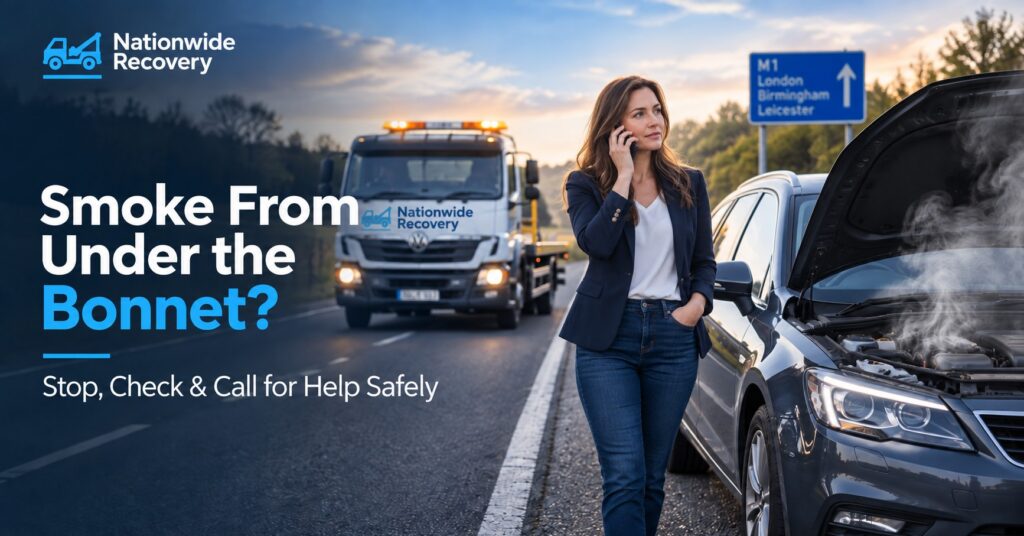
If your car is smoking under the bonnet, move to a safe stopping place, switch off the engine and keep everyone away from moving traffic. If you see flames, heavy smoke or clear signs of fire, do not open the bonnet. Move away and call 999 for the fire service.
If the problem appears to be steam or light smoke, still avoid continuing your journey until the vehicle has cooled and the cause has been assessed.
UK fire and rescue services attended 19,600 road vehicle fires in England during the year ending March 2026, according to government statistics. That was 5.7% more than the previous year.
National Highways also says its traffic officers handle more than 85,000 breakdowns each year, with over 40% linked to fuel, tyres, power loss or engine trouble.
This guide explains what the smoke may mean, what to check safely and when to call Nationwide Recovery for professional help.
What Should You Do First?
If smoke appears from under the bonnet while you are driving, reduce speed smoothly and move towards a safe stopping place. Switch off the engine once stopped and avoid standing near moving traffic.
Use this order:
- Check mirrors and surrounding traffic.
- Signal and move left when safe.
- Use hazard lights if the vehicle becomes an obstruction.
- Stop away from moving traffic.
- Apply the parking brake.
- Switch off the engine.
- Move passengers to a safer position.
- Assess the situation from a safe distance.
Do not continue driving simply to see whether the smoke clears.
If the vehicle cannot continue safely, Nationwide Recovery provides 24/7 breakdown recovery.
Is It Smoke or Steam?
Smoke and steam can look similar from a distance. Steam is often linked to hot coolant or overheating, while smoke may come from oil, electrical components, fuel or another fluid touching hot surfaces.
Do not rely only on colour.
Instead, consider:
- where it is coming from;
- whether the temperature gauge is high;
- whether a warning light appeared;
- whether there is a burning smell;
- whether the cloud disappears quickly;
- whether flames are visible.
RAC notes that smoke from an engine bay may relate to coolant, oil, wiring or other hot components.
The safest approach is to treat unexplained under-bonnet smoke seriously until the cause is known.
When Should You Call 999?
Call 999 and ask for the fire service if you see flames, rapidly increasing smoke or clear signs that the vehicle is on fire. Move everyone well away and do not attempt to open the bonnet.
GOV.UK guidance says that if a vehicle catches fire, occupants should leave quickly and move somewhere safe. It also warns against opening the bonnet because additional air can make an engine-compartment fire flare.
Hampshire & Isle of Wight Fire and Rescue Service gives similar guidance:
- stop safely;
- switch off the engine;
- get everyone out;
- move away;
- call 999;
- do not open the bonnet.
Emergency services take priority over roadside recovery when there is an active fire.
Should You Open the Bonnet?
Do not open the bonnet if you suspect an engine-compartment fire. If the issue appears to be overheating or steam instead, wait until the vehicle has cooled before considering any basic inspection.
Heat, steam and pressurised coolant can cause injury.
Never immediately remove:
- a radiator cap;
- coolant reservoir cap;
- pressurised cooling-system cap.
The Highway Code states that an overheated engine should be allowed to cool naturally before the coolant filler cap is removed.
If you are unsure, leave the bonnet closed and arrange professional help.
What Causes Smoke Under the Bonnet?
Smoke or steam from the engine bay can have several causes.
| Possible Cause | Typical Clue | Recommended Action |
| Coolant leak | White steam, rising temperature | Stop and allow engine to cool |
| Oil leak | Burning-oil smell, grey/blue haze | Arrange inspection |
| Overheating | High temperature gauge, steam | Stop safely and switch off |
| Electrical fault | Acrid burning smell, smoke | Keep clear and seek help |
| Fluid on hot engine | Smoke after driving | Professional inspection |
| Damaged hose | Steam or visible fluid | Do not continue if overheating |
| Fuel-related issue | Strong fuel smell or dark smoke | Switch off and seek help |
| Engine fault | Warning lights or poor running | Diagnostics or recovery |
These are only symptom patterns.
They should not be used as a remote mechanical diagnosis.
What Does the Smoke Colour Mean?
Smoke colour may offer clues, but it does not confirm a fault.
White Smoke or Steam
White vapour from under the bonnet often points towards coolant or water contacting hot engine components. If the temperature gauge is also high, overheating becomes more likely.
Possible causes include:
- coolant leak;
- damaged hose;
- radiator issue;
- expansion-tank leak;
- cooling-system fault.
Wait for the engine to cool fully.
Do not remove a hot coolant cap.
Blue or Grey Smoke
Blue or grey smoke can appear when oil or another fluid reaches a hot engine or exhaust component. A burning-oil smell may be present.
Possible sources include:
- oil leak;
- spilled engine oil;
- damaged seals;
- fluid reaching the exhaust manifold.
Arrange professional inspection before deciding whether the vehicle should continue.
Dark Smoke
Dark smoke from the engine bay should be treated cautiously, especially when combined with a strong burning or electrical smell.
Switch off the engine.
Keep away from the vehicle if the smoke increases.
Call 999 if fire is suspected.
Could the Engine Be Overheating?
Yes. Steam from under the bonnet can be a sign that coolant is boiling or escaping from the cooling system. A high temperature gauge or temperature warning light makes overheating more likely.
National Highways advises drivers to find somewhere safe to stop if the engine begins overheating and allow it to cool.
Other signs can include:
- temperature gauge rising;
- coolant warning;
- reduced performance;
- sweet coolant smell;
- steam after stopping.
Do not continue driving an overheating vehicle simply because it still moves normally.
Can an Oil or Coolant Leak Cause Smoke?
Yes. Oil or coolant leaking onto a hot surface can create visible smoke or steam. The vehicle may continue running, but the cause still needs assessment before normal driving resumes.
Oil often produces a noticeable burning smell.
Coolant may create white steam.
You may also notice:
- fluid underneath the car;
- declining fluid level;
- dashboard warning;
- smoke appearing after stopping.
Do not touch hot fluids.
Do not crawl underneath a roadside vehicle.
If the cause is unclear, Nationwide Recovery offers vehicle diagnostics to help identify vehicle faults.
Could It Be an Electrical Problem?
Electrical wiring or components can produce smoke and a distinctive burning smell when overheated. Switch the vehicle off and avoid touching damaged wiring or electrical components.
Warning signs may include:
- sharp electrical smell;
- flickering lights;
- multiple dashboard warnings;
- smoke near wiring;
- sudden electrical failure.
If smoke increases or fire is suspected, move away and call 999.
Do not attempt a roadside electrical repair.
What If There Is a Burning Smell?
A burning smell can be useful information for a technician.
Possible smells include:
Burning Oil
Often sharp and oily.
This may suggest fluid has contacted a hot surface.
Sweet Smell
Coolant often has a distinctive sweet smell.
Combined with steam, this may indicate a cooling-system leak.
Electrical Smell
Hot wiring or plastic can create an acrid smell.
Treat visible smoke with extra caution.
Fuel Smell
A strong petrol or diesel smell deserves immediate attention.
Switch the engine off and avoid ignition sources.
The Highway Code advises motorists to investigate unusual smells such as burning rubber, petrol or electrical faults immediately.
What If the Smoke Stops?
Smoke disappearing does not necessarily mean the underlying issue has resolved. Heat-sensitive leaks or intermittent electrical faults can stop temporarily once the engine is switched off.
Do not assume the vehicle is ready to continue.
Record:
- smoke colour;
- smell;
- dashboard warnings;
- engine temperature;
- where the smoke appeared;
- how long it lasted.
This information can help a technician identify the cause.
What If the Car Runs Normally?
A vehicle can still appear to run normally while a leak or developing fault creates smoke.
For example, oil may drip onto a hot component without immediately affecting engine performance.
Coolant may also leak gradually before the temperature rises.
Therefore, normal engine performance alone should not determine whether you continue your journey.
Arrange an inspection if unexplained smoke appeared.
What If It Happens on a Motorway?
If smoke appears while driving on a motorway, move towards the safest available place without making abrupt manoeuvres. Leave at the nearest safe opportunity or move into an emergency area or hard shoulder when available.
Do not stop in a live lane unless you have no safe alternative.
Once stopped:
- switch on hazards;
- turn the engine off;
- exit away from traffic if safe;
- move behind a barrier where possible.
If you cannot safely leave a live lane, keep seatbelts fastened and contact emergency services.
National Highways advises drivers with vehicle problems to leave the carriageway at the next safe opportunity wherever possible.
For wider breakdown safety advice, see What to Do When Your Car Breaks Down: Step-by-Step Guide.
Can You Drive to a Garage?
Do not continue driving when smoke, steam, overheating or a strong burning smell suggests an active vehicle fault. Arrange professional advice or recovery instead.
Continuing may make diagnosis more difficult.
It can also leave you stranded somewhere less suitable.
A recovery operator can assess the situation and move the vehicle to:
- your home;
- a garage;
- a dealership;
- another agreed destination.
Do You Need Recovery or Diagnostics?
Use the symptoms to decide what help is most appropriate.
| Situation | Likely Next Step |
| Light smoke stopped, cause unknown | Diagnostics |
| Vehicle overheated | Professional assessment |
| Engine will not restart | Breakdown recovery |
| Smoke with warning lights | Diagnostics/recovery |
| Fire suspected | 999 first |
| Vehicle cannot continue safely | Recovery |
| Safe roadside issue | Roadside assistance |
Nationwide Recovery provides roadside assistance for suitable roadside situations.
If the vehicle cannot continue safely, recovery can be arranged.
What Should You Tell Recovery?
Give the operator clear information.
Location
Provide:
- road name;
- postcode;
- direction of travel;
- nearest junction;
- landmark;
- map pin.
Vehicle
Provide:
- registration;
- make;
- model;
- fuel type.
Symptoms
Explain exactly what happened.
For example:
- “White steam came from the bonnet.”
- “I smelled burning oil.”
- “The temperature gauge went high.”
- “Smoke appeared after I stopped.”
- “An engine warning light came on.”
Avoid guessing which component failed.
How Can You Reduce the Risk?
Regular vehicle checks can help identify some problems before they become roadside issues.
National Highways recommends checking oil, fuel, tyres, lights and other basic vehicle items before journeys.
Pay particular attention to:
Coolant
Check the level only when the engine is cool.
Follow the manufacturer’s handbook.
Engine Oil
Check the oil regularly.
If you need frequent top-ups, arrange an inspection.
Dashboard Warnings
Do not ignore recurring temperature, oil or engine warnings.
Visible Leaks
Look for fresh fluid beneath the vehicle.
Unusual Smells
Investigate new burning, fuel or coolant smells.
Servicing
Follow the vehicle manufacturer’s service schedule.
Smoke Under Bonnet Checklist
Use this simple sequence:
SMOKE APPEARS → STOP → SWITCH OFF → STAY SAFE → GET HELP
- Move to a safe location.
- Turn hazards on when appropriate.
- Switch the engine off.
- Keep away from traffic.
- Look for flames from a safe distance.
- Do not open the bonnet if fire is suspected.
- Do not remove a hot coolant cap.
- Note warning lights and smells.
- Call 999 for an active fire.
- Arrange roadside help or recovery.
Need Help With a Smoking Car?
If your car is smoking under the bonnet, do not rely on guesswork.
Stop somewhere safe, switch off the engine and assess the situation from a safe position.
Nationwide Recovery provides 24/7 breakdown recovery, roadside assistance and vehicle diagnostics for motorists who need professional help.
Call Nationwide Recovery: 0161 706 0346
Frequently Asked Questions
Question: What should I do if my car is smoking under the bonnet?
Answer: Move to a safe place, turn the engine off and keep away from traffic. If you see flames, heavy smoke or clear signs of fire, do not open the bonnet. Move away and call 999 for the fire service.
Question: Can I drive if smoke is coming from the bonnet?
Answer: It is safer to stop and identify the situation before continuing. Smoke may come from coolant, oil, electrical components or another vehicle fault that needs professional assessment.
Question: Should I open the bonnet if my car is smoking?
Answer: Do not open the bonnet when you suspect an engine-compartment fire. If the issue appears to be overheating or steam, wait until the vehicle has fully cooled before considering any basic inspection.
Question: Is white smoke under the bonnet usually coolant?
Answer: White vapour can be steam from coolant reaching hot engine components, especially when the engine is overheating. However, the exact cause should be confirmed rather than diagnosed by colour alone.
Question: Why is my car smoking but not overheating?
Answer: Smoke without a high temperature reading can come from oil, other fluids, wiring or residue contacting hot components. A diagnostic inspection can help identify the source.
Question: Can an oil leak cause smoke under the bonnet?
Answer: Yes. Oil reaching a hot engine or exhaust surface can create smoke and a burning-oil smell. The source of the leak should be identified before normal driving continues.
Question: When should I call 999?
Answer: Call 999 when there are flames, rapidly increasing smoke or another clear sign of a vehicle fire. Get everyone away from the vehicle and ask for the fire service.
Question: Should I call breakdown recovery if the smoke stops?
Answer: Yes, professional assistance can still be appropriate because an intermittent leak, overheating event or electrical fault may stop producing smoke temporarily while the underlying cause remains.